
In Brief
- Revenge trading usually starts as a state shift (ego, boredom, urgency), not a strategy flaw—so you need rules that trigger before you spiral.
- A funded trader’s “seatbelt system” is simple: daily loss limit + trade limit + time cutoff + cooldown after stop-outs.
- If your edge is built for the open, don’t force it into midday chop. Use volatility/ATR and tempo as your cue to stop, adapt, or sit out.
You’re up in the morning. You’re reading the tape well. Then the afternoon shows up and you start “looking” for trades.
It rarely feels like, “I’m about to revenge trade.” It feels like: one more setup, I can get it back, I’m already here anyway.
And the most frustrating part? You can hear the rational voice saying, “This isn’t it.” …while your hand still clicks.
That gap—between knowing and doing—is where most prop trading accounts get cooked. Not by one bad trade. By the sequence that comes after the first emotional hit.
This article gives you a funded-trader risk management plan that shuts that sequence down with daily stop rules that actually get followed.
Revenge Trading Isn’t a Strategy Problem—It’s a Trading Psychology State
Revenge trading is what happens when you try to regulate an emotion with a position.
A few common triggers:
- You give back a chunk of unrealized or realized gains
- You take a clean stop-loss and feel disrespected by the market
- You miss a move and feel late
- You get bored and start inventing “opportunity” — a pattern we break down in our guide on boredom-driven trading
Prop trading makes this worse because the constraints are real:
- daily loss limits
- trailing drawdowns
- tight risk rules
- evaluation pressure
So here’s the mindset shift that changes everything:
You don’t need more willpower. You need a system that removes decision-making when your state is compromised. For a complete behavior framework, see our 12 rules to stop revenge trading.
Reality check: If your plan requires “discipline” during your most emotional 90 seconds (right after a stop-out), it’s not a plan. It’s a hope.
Why Revenge Trading Blows Up Funded Trader Accounts Fast
Revenge trading almost never destroys you with one oversized loss.
It destroys you with behavior drift:
- more trades than normal
- weaker entries
- chasing
- switching strategies midstream
- moving stops or “re-optimizing” on the fly
- size creep (“just this once”)
In a funded account, that drift hits hard because the rules don’t care that you were green an hour ago.
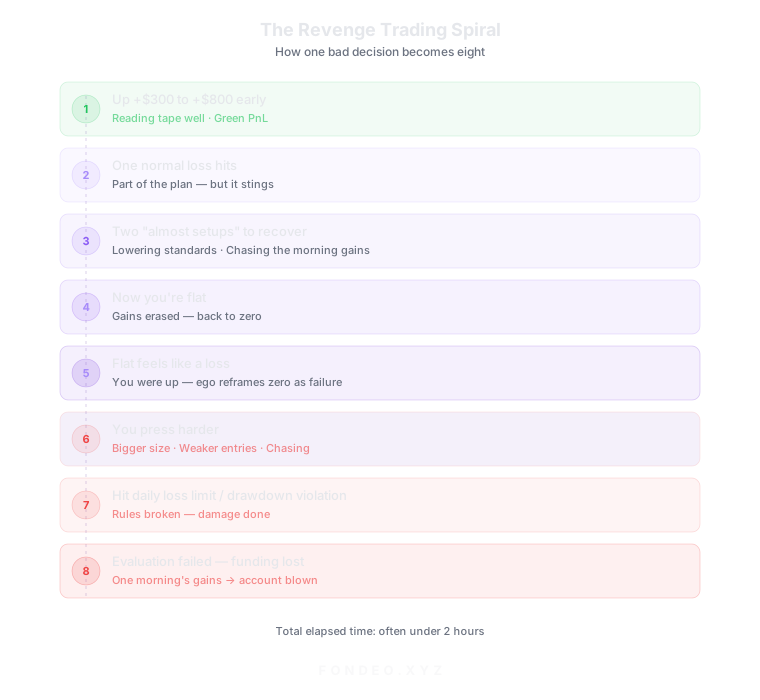
A common funded-trader failure pattern looks like this:
- You’re up +$300 to +$800 early.
- One normal loss hits.
- You take two “almost setups” to get it back.
- Now you’re flat.
- Flat feels like a loss because you were up.
- You press.
- You hit daily loss or violate drawdown rules.
- Evaluation failed—or funding lost.
The market doesn’t pay you for your morning.
It pays you for the quality of your next decision.
And in prop trading, your #1 job isn’t to make money today.
Your #1 job is to stay eligible to make money tomorrow.
The Funded Trader Daily Stop Framework (Your Seatbelt System)
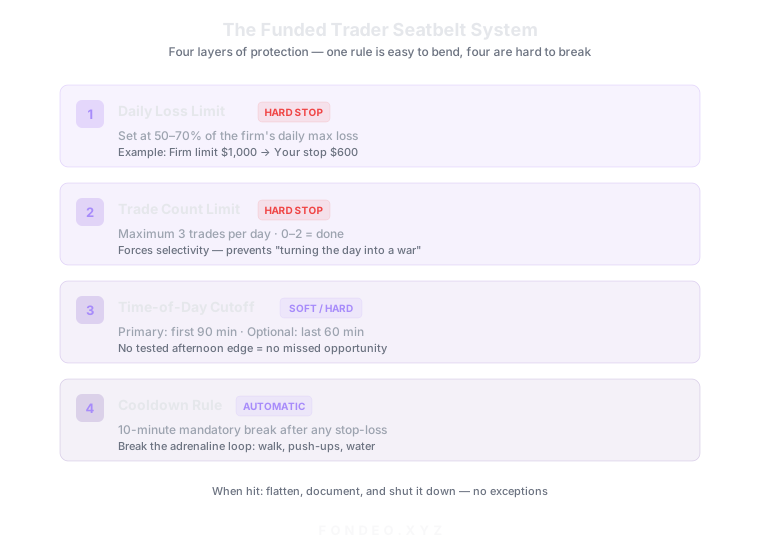
A prop-trading risk plan should have layers. One rule is easy to bend. Four rules are hard to break.
Use these four:
- Daily loss limit (hard stop)
- Trade count limit (hard stop)
- Time-of-day cutoff (soft or hard stop)
- Cooldown rule (automatic pause after stop-outs)
Daily Loss Limit (Hard Stop)
This is non-negotiable.
For prop trading, set your personal daily max loss below the firm’s limit.
A practical range:
- 50–70% of the firm’s daily max loss
Why leave buffer?
- slippage
- partial fills
- mistakes (double entries happen)
- the day you’re slightly off
Example: If the firm’s daily max loss is $1,000, set your internal stop at $600.
When hit: flatten, document, and shut it down.
Rule that keeps you funded: The best traders don’t “use the full daily loss.” They treat it like a fire alarm—if it goes off, something in the process is wrong today.
Trade Count Limit (Hard Stop)
Overtrading is often death by a thousand clicks.
A simple, prop-friendly trade count limit:
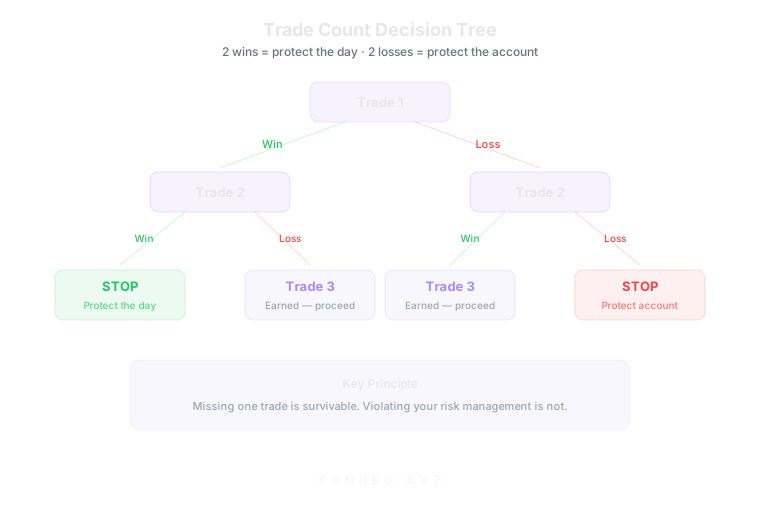
- Max 3 trades per day
- If you go 0–2 (two losses), you’re done
Or, if you want something that rewards clean execution:
- 2 wins = stop (protect the day)
- 2 losses = stop (protect the account)
- 1 win / 1 loss earns a 3rd trade
This is powerful because it forces selectivity. It also prevents you from “turning the day into a war.”
If you’re thinking, “But what if the best setup comes later?”—good.
That thought is the addiction talking. The funded trader response is:
Missing one trade is survivable. Violating your risk management is not. And if a bad day has already turned into a deep hole, follow a protocol to recover after a big loss instead of forcing the trade cap into a comeback attempt.
Time Cutoff: Don’t Force the Open Edge Into Midday Chop
Many traders have one core edge—often built for the first 60–120 minutes when volatility and volume are strongest.
Later, the tape changes:
- smaller candles
- weaker follow-through
- more mean reversion
- more chop around VWAP/levels
If you keep trading the same momentum breakout/breakdown approach as ATR and tempo compress, you’ll start seeing breakouts everywhere.
That’s how you donate mornings.
Prop-specific solution: define your trading windows.
Common structure:
- Primary window: first 90 minutes of NY
- Optional window: last 60 minutes (only if you’ve tested an edge there)
No tested afternoon edge? Then you don’t have “missed opportunity.”
You have protected capital.
Cooldown Rules: The 10-Minute Reset That Saves Accounts
This is the highest-leverage trading psychology tool in this whole plan.
Rule: After any stop-loss, you must leave your screen for 10 minutes.
Physically.
Do something that breaks the adrenaline loop:
- 20–40 push-ups
- a short walk outside
- stretch + water
- quick shower
The point isn’t fitness. It’s state disruption.
Those first seconds after a stop-out are when your brain is most likely to:
- “get it back”
- lower standards
- chase
- click without a real trigger
Pro Tip: If you can’t control your hand, control your environment. Stand up, change rooms, and remove the trigger.
A Prop Trading Risk Plan You Can Implement Tomorrow (Copy/Paste)
You don’t need a complicated manifesto. You need a one-page rule set you’ll follow.
Define Your A-Setup in Yes/No Language
Vague criteria creates discretionary chaos.
Write your A-setup so you can’t argue with it.
Example A-setup checklist (adapt to your system):
- Market structure is clear (trend or defined range)? Yes/No
- Volatility/ATR supports my targets today? Yes/No
- Key level is present (PDH/PDL, ORH/ORL, HTF level, VWAP context)? Yes/No
- Trigger appears (break + retest, sweep + reclaim, pullback to level, etc.)? Yes/No
- Stop is logical and fixed before entry? Yes/No
- R-multiple makes sense (not forcing 1:1 in chop)? Yes/No
If you can’t answer yes/no, you’re not trading a plan.
You’re trading a mood.
Write Your Daily Stops (So You Stop Negotiating)
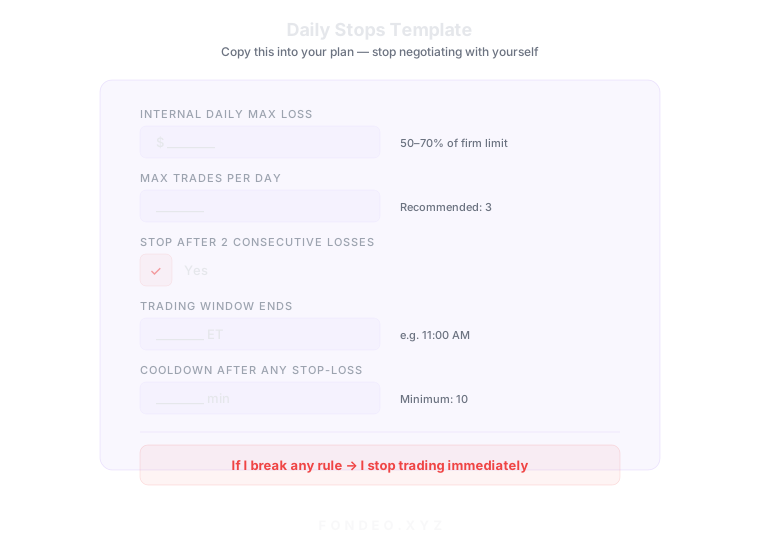
Copy this format into your plan:
- Internal daily max loss: $____
- Max trades: ____
- Stop after 2 consecutive losses: Yes/No
- Trading window ends: ____ (e.g., 11:00 AM ET)
- Cooldown after any stop-loss: ____ minutes (minimum 10)
Now add the rule most traders avoid:
- If I break any rule, I stop trading immediately.
In prop trading, rule-breaking is the real account killer—because it’s how one bad decision turns into ten.
Build a “Tilt Trigger” List (Your Early Warning System)
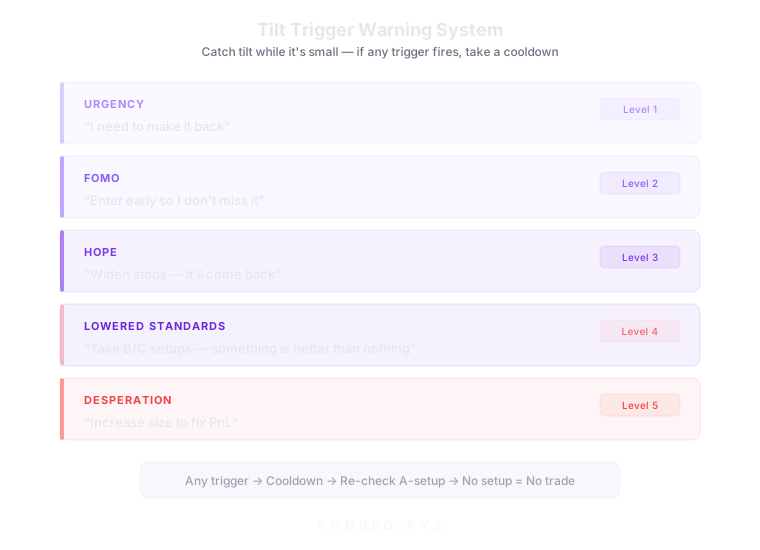
Your goal is to catch tilt while it’s still small.
Common tilt triggers:
- you feel urgency: “I need to make it back”
- you enter early “so you don’t miss it”
- you widen stops after entry
- you start taking B/C setups
- you increase size to fix PnL
When a trigger hits: cooldown, then re-check the A-setup checklist.
No A-setup? No trade.
Use the “Sim Switch” Instead of Breaking Rules
This is a clean compromise for curious, high-screen-time traders.
When you hit your daily stop rules:
- switch to sim
- keep watching
- take the trades you want to take
- review them later
You still learn. You still satisfy the itch.
But you stop paying tuition with your funded trader account.
End-of-Day Review (5 Minutes)
Your journal is not a diary. It’s a coaching report.
Answer:
- Did I follow my daily stop rules? Yes/No
- How many trades were A-setups vs impulse trades?
- What time did my edge perform best today?
- What was I feeling right before my worst trade?
Keep it short. Keep it honest.
The Biggest Prop-Trading Mistakes Behind Overtrading
Mistake 1: Trying to Trade More Hours With One Edge
If your edge depends on volatility, it will degrade in chop. Learn to recognize regime mismatch before it costs you.
Your three options:
- adjust expectations (smaller targets, different management)
- switch playbook (more mean reversion, different triggers)
- stop trading that session
Professional trading is adaptation or patience. Not stubbornness.
Mistake 2: Thinking Overtrading Means “Too Many Trades”
Sometimes it does.
But the more accurate definition is:
Overtrading = taking trades when your edge is not present.
If every trade you take is truly positive expectancy, then taking more isn’t the problem.
The real issue is pretending your edge exists because you want action.
So get specific:
- What volatility/ATR conditions does your setup require?
- What time-of-day supports it?
- What market structure invalidates it?
When you can answer those, patience stops being “discipline.”
It becomes logic.
Mistake 3: Having Only a Dollar Stop (No Behavior Stops)
If your only guardrail is money, you can still do damage fast—especially with multiple rapid trades.
That’s why prop traders need behavior rules:
- trade caps
- session windows
- cooldowns
Risk management is not one line in your plan.
It’s the framework that keeps you funded.
Mistake 4: Waiting for It to “Click” After Enough Pain
Pain can teach you.
It can also push you into worse habits—fear, hesitation, or bigger revenge swings.
You don’t need another blown evaluation to grow up.
You need a repeatable system that protects you while you improve.
Build the Skill of Stopping (This Is What Keeps You Funded)
Your goal isn’t to never feel revenge.
Your goal is to feel it—and follow your rules anyway.
Practice Stopping on Purpose
Most traders practice entries.
Funded traders practice stopping.
Twice this week:
- hit your time cutoff or a reasonable profit objective
- close the platform
- walk away while price is still moving
You’re training your brain to learn: stopping is safe.
Use a “Green Day Lock” Rule
If you’re in a challenge or newly funded, green days are assets.
Try one of these:
- After +2R, you’re done for the day
- After you’re green, you switch to A+ only mode (no “maybe” trades)
This is how you prevent the classic give-back.
Create a Post-Stop Routine (Automatic)
After a stop-out:
- Stand up immediately
- Drink water
- 10-minute walk or push-ups
- Re-open chart and re-check A-setup criteria
No clear setup? You do nothing.
Doing nothing is not laziness.
It’s professional restraint.
Pro Tip: Your best trading days often include long stretches of no trading. That’s not a flaw. That’s selectivity.
Action Checklist (Print This Before Your Next Session)
- [ ] I will trade only my defined session window(s).
- [ ] I will take a maximum of __ trades today.
- [ ] If I go 0–2, I am done for the day.
- [ ] After any stop-loss, I take a 10-minute cooldown away from the screen.
- [ ] I will not enter without a full A-setup checklist.
- [ ] If I hit my internal daily loss, I stop—no exceptions.
- [ ] If I want to stay engaged, I switch to sim, not risk.
- [ ] I journal for 5 minutes and score my execution.
Track one metric above all:
Rule adherence % — and track it honestly every session.
Because when rule adherence rises, consistency rises.
And when consistency rises, passing an evaluation—and staying funded—stops being a dream and becomes the natural result.
You don’t need a perfect day. You need a controlled day.
Implement the daily stops, honor the cooldown, and only trade when your edge is actually present.
If you want a structured path to build these funded trader habits and apply prop-trading risk management without burning accounts along the way, start your journey at Fondeo.xyz.
Trade smart. Protect your capital. Stay in the game.