
Most traders start the same way: you open your platform, take trades, and end the day asking one question—“Did I make money?”
When the answer is “no,” it’s easy to spiral. You tweak your entries. You jump timeframes. You add indicators. You take one more trade to “make it back.”
In prop trading, that spiral doesn’t just hurt your confidence. It puts you on a collision course with the two things that end evaluations fast:
- rule violations
- losses that compound because your process broke
The fix isn’t another indicator.
It’s a better scoreboard.
A daily discipline score is one of the simplest process metrics you can use to improve trading psychology, strengthen risk management, and stay inside prop rules—so your PnL has a chance to follow.
In Brief
- You’ll separate good trading from lucky PnL by measuring behaviors you control, not outcomes you can’t.
- You’ll get a plug-and-play discipline score (simple and weighted versions) designed for prop trading and funded-account rules.
- You’ll learn a weekly review method that reduces rule breaks, stabilizes your mindset, and helps you pass the challenge and stay funded.
Why PnL Is a Bad Daily Scoreboard (and a Great Monthly One)
PnL tells you what happened. It doesn’t reliably tell you why it happened.
A trader can follow the plan perfectly, take two A+ setups, respect risk, and still finish red. Another trader can chase a move, oversize, move a stop, get lucky on a spike—and finish green. That’s why it helps to know whether your edge is real or just a hot streak before you trust the scoreboard.
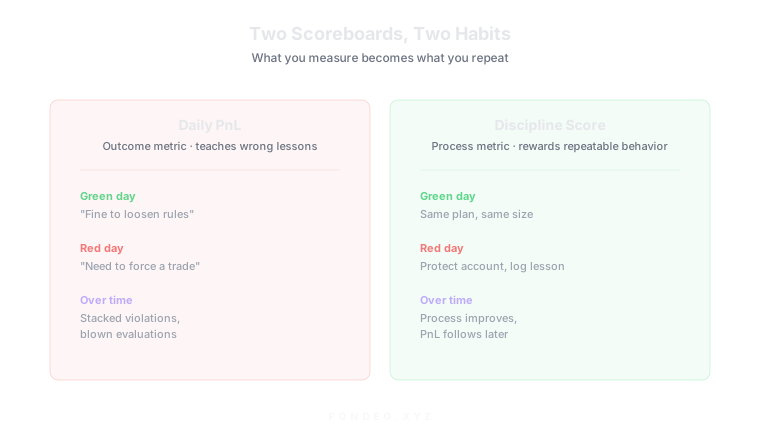
If you only track daily PnL, your brain learns the wrong lesson:
- Green day → “I’m fine to loosen rules.”
- Red day → “I need to force something.”
That feedback loop is exactly how “one normal loss” becomes a max daily loss violation.
Pro tip: PnL is a great result metric over a large sample. Intraday, it’s often a terrible teacher. It can reward bad behavior and punish good execution.
A discipline score flips your focus back to what actually creates boring consistency:
- You measure what you control.
- You reward behaviors that protect capital.
- You penalize behaviors that break prop rules.
Do that long enough and the “weird” thing happens: PnL improves later because your process improves first.
What a Discipline Score Is (and Why Funded Traders Need It)
A discipline score is a daily numeric rating of your execution quality.
Not vibes. Not “I think I did okay.” A real score that reflects whether you traded like a funded trader should trade.
In a funded account, the biggest threat usually isn’t your strategy. It’s the moment you violate a constraint:
- exceeding max daily loss
- breaching overall drawdown
- risking too much per trade
- widening stops or averaging down outside plan
- revenge trading after a loss
- overtrading in chop
Most blown accounts aren’t caused by one “bad setup.” They’re caused by stacked violations—small cracks that turn into a collapse.
A discipline score helps you catch that slide early.
Pro tip: The goal isn’t to “be disciplined.” The goal is to make undisciplined behavior expensive on paper so you stop justifying it in real time.
The Plug-and-Play Discipline Score (Weighted, Prop-Trading Specific)
Start with 6–10 behaviors that directly impact:
- your risk management
- your adherence to prop trading rules
- your ability to execute your edge consistently
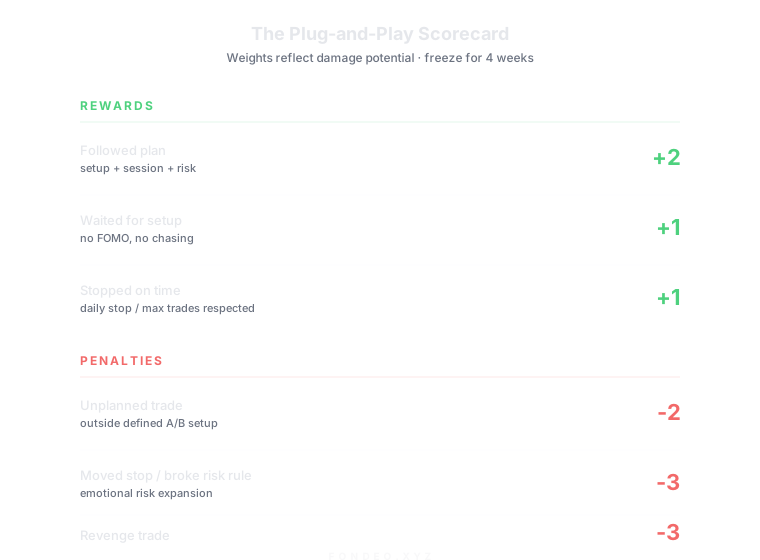
A strong starter scorecard
Rewards
- +2 Followed plan (setup + session rules + risk)
- +1 Waited for your setup (no FOMO)
- +1 Stopped on time (daily stop / max trades respected)
Penalties
- -2 Took an unplanned trade
- -3 Moved stop / violated risk rules
- -3 Revenge trade (impulse trade to “get it back”)
Simple enough to do in a notebook. Specific enough to change behavior.
How to choose the point weights
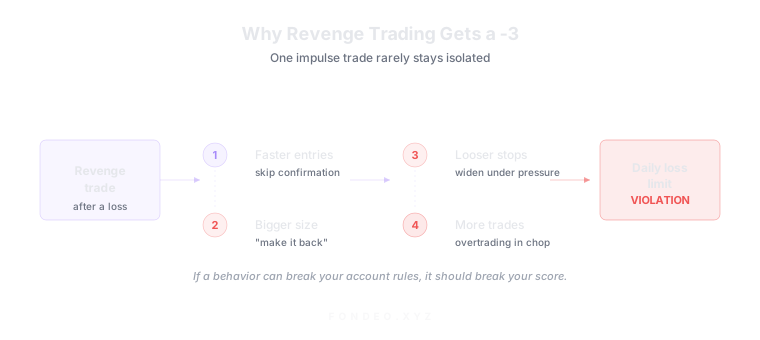
Weights shouldn’t be random. In prop trading, weight should reflect damage potential.
- Small mistakes get smaller penalties.
- Account-threatening behavior gets heavy penalties.
Revenge trading gets hit hard because it rarely stays isolated. It usually triggers:
- faster entries
- bigger size
- looser stops
- more trades
That sequence is how traders violate daily loss limits—which is why a hard daily stop to shut revenge trading down belongs at the top of your scorecard.
Moving a stop is also heavily penalized because most of the time it’s not “active trade management.” It’s emotional risk expansion.
Pro tip: If a behavior can break your account rules, it should break your score.
The ultra-simple “Yes/No” version
If you’re currently inconsistent, start even simpler:
- 1 point if you followed your plan today
- 0 points if you broke any non-negotiable rule
Then write one line:
- “The rule I broke was ______.”
This version is blunt—and that’s why it works.
Once you’re consistent, move to weighted scoring so you can diagnose which behaviors need work.
Build Your Discipline Score in 5 Steps (Built for Prop Rules)
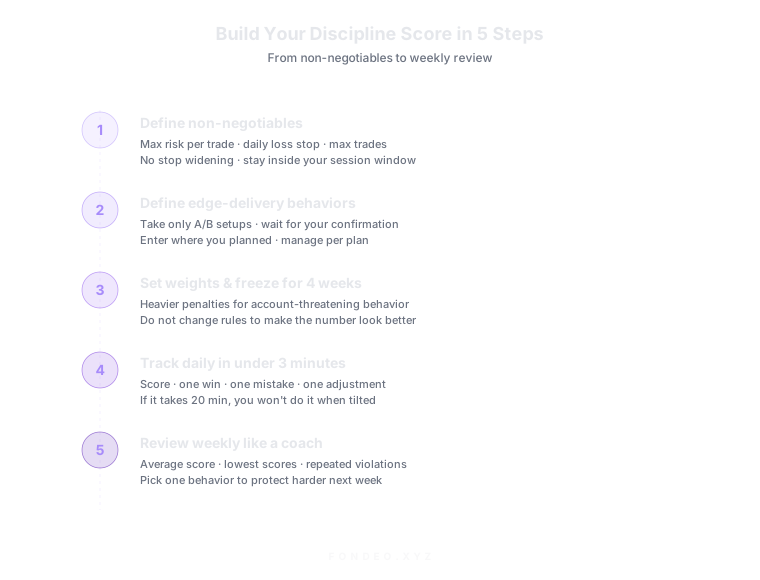
Define your non-negotiables (account protection rules)
These are the rules that can end an evaluation or funded account.
Examples:
- max risk per trade (set it to fit your prop firm’s limits)
- a hard daily loss limit stop (not a suggestion)
- max number of trades per session
- no stop widening
- no trading outside your defined session window
These get the biggest penalties.
Define your “edge delivery” behaviors
These are the actions that deliver your strategy’s edge.
Examples:
- only take A/B setups (define what qualifies)
- wait for confirmation you personally use (structure break, sweep/reclaim, trend alignment, etc.)
- enter where you planned (no chasing)
- manage the trade according to plan (partials, breakeven rules, exit triggers)
These get rewarded.
Set weights and freeze them for 4 weeks
Most traders sabotage themselves here.
They change the scoring system every week to make the number look better. That destroys the data.
Do this instead:
- choose your weights
- freeze them for 4 weeks
- review and refine after you have a real sample
Consistency in measurement creates clarity.
Track it daily in under 3 minutes
If it takes 20 minutes, you won’t do it when trading gets stressful.
Use this template:
- Discipline Score: ____
- One thing I did well: ____
- One mistake / near-miss: ____
- One adjustment for tomorrow: ____
Fast. Repeatable. Effective.
Review weekly like a coach, not a critic
Your weekly review is where improvement compounds.
Answer:
- What was my average score?
- What caused the lowest scores?
- What violations repeated?
- What’s the one behavior I will protect harder next week?
Your job isn’t to shame yourself. Your job is to coach yourself.
Pro tip: A trader with an average strategy and elite process often outperforms a trader with a great strategy and sloppy execution—especially in a funded account.
How to Use Your Score to Improve PnL (Without Chasing PnL)
This is where discipline scoring becomes a real performance system.
Set score targets instead of money targets
Replace “I need $500 today” with something you control:
- “I want a +4 or higher day.”
- “No -3 penalties this week.”
- “Max two planned trades.”
Money targets pressure you into action. Score targets pressure you into correct action.
Add a stoplight system (rule-based permissions)
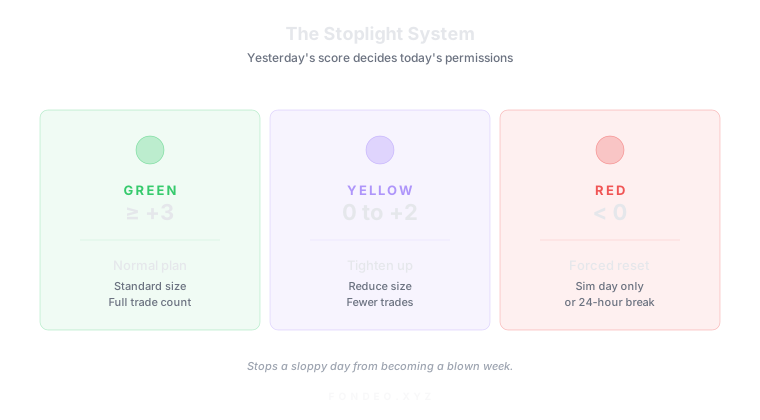
Use the score to decide what you’re allowed to do tomorrow:
- Green (≥ +3): normal plan
- Yellow (0 to +2): reduce size or reduce trades
- Red (< 0): forced sim day or 24-hour reset
That one simple system prevents a sloppy day from becoming a blown week.
Pair the score with one risk metric
Keep this lightweight. Pair your discipline score with one of these:
- number of rule violations
- average R per trade
- % of trades that matched your setup
- max adverse excursion (MAE) on your A+ setups
This keeps you grounded in risk management while you improve execution.
Pro tip: Your goal isn’t to be right. Your goal is to be repeatable.
Common Discipline Score Mistakes (and How to Fix Them)
Changing the scoring rules to feel better
If you change weights every few days, your “progress” might just be accounting.
Freeze the rules for a month. Then adjust.
Scoring based on outcome
Don’t do this:
- “I got stopped out, so -1.”
A stop-out can be a perfect trade.
Score the process:
- Did it match your setup?
- Did you size correctly?
- Did you manage it according to plan?
Making it too complex to maintain
Automation can be great, but it’s not step one.
Step one is consistency.
If you can’t maintain the score for 10 straight trading days, you don’t need a more advanced system—you need a simpler one.
Turning trailing stops into a moral debate
A trailing stop-loss isn’t “bad.” A trailing stop can be excellent if it’s part of your plan—but beware of moving to breakeven out of fear.
The problem is emotional trailing:
- you trail too tight because you’re scared
- you trail randomly because you “don’t want to lose”
- you change the plan mid-trade because PnL is talking
If your plan says “trail after X is hit,” that’s discipline.
If you trail because you’re anxious, that’s fear dressed up as trade management.
Pro tip: It’s not the tool. It’s whether you used the tool as planned.
Make Discipline Scoring a Habit (So It Works Under Pressure)
Funded traders don’t rely on motivation. They rely on systems they can run when they’re tired, tilted, or busy.
The 2-minute close-out routine
Do this immediately after your session:
- Screenshot your best setup (even if it lost)
- Screenshot your worst decision (even if it won)
- Write your discipline score
- Write one sentence: “Tomorrow I will protect ______.”
That’s it.
Score the small wins (this rebuilds identity)
If you’re rebuilding consistency, you need the right definition of “winning.”
A win can be:
- stopping after two trades
- not revenge trading after a loss
- taking no trade because the setup wasn’t there
That’s how you build the funded-trader identity:
- “I stop on time.”
- “I don’t widen stops.”
- “I only take my setup.”
Your PnL doesn’t improve because you want it.
It improves because you become the type of trader who can execute a repeatable process.
Pro tip: Your discipline score is your professionalism score. Act like a pro long enough and you start getting paid like one.
Copy-Paste Checklist: Daily Discipline Score (10-Day Starter)
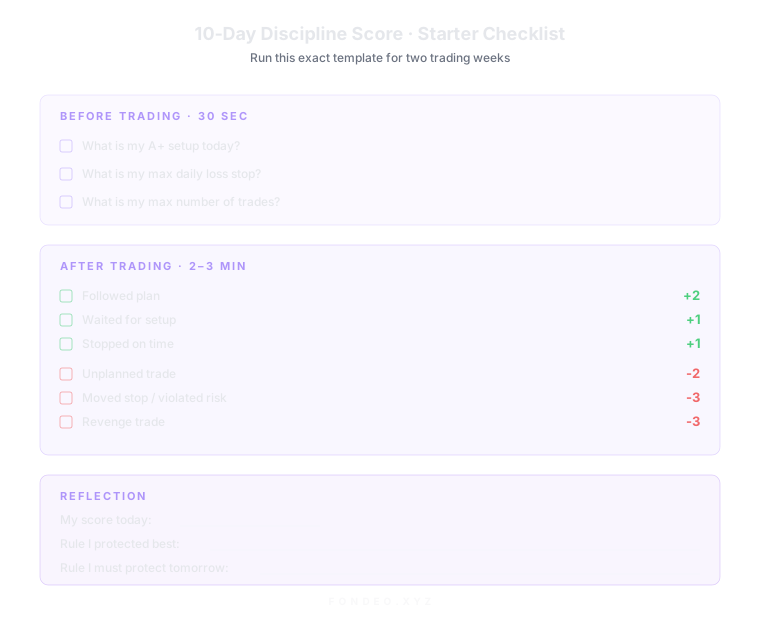
Use this checklist as-is for the next 10 trading days.
Before trading (30 seconds)
- [ ] What is my A+ setup today?
- [ ] What is my max daily loss stop?
- [ ] What is my max number of trades?
After trading (2–3 minutes)
- [ ] Followed plan (+2)
- [ ] Waited for setup (+1)
- [ ] Stopped on time (+1)
- [ ] Unplanned trade (-2)
- [ ] Moved stop / violated risk (-3)
- [ ] Revenge trade (-3)
Reflection
- [ ] My score today: ____
- [ ] The rule I protected best: ____
- [ ] The rule I must protect tomorrow: ____
Run this for two weeks and you’ll start seeing patterns you can actually fix.
Consistency beats intensity in prop trading. Every time.
Your Next Action (Do This Tonight)
- Write your scoring list (start with the template above).
- Print it or pin it next to your screen.
- Commit to 10 straight trading days of scoring—regardless of PnL.
- Keep weights fixed for 4 weeks.
- Do one weekly review and choose one behavior to eliminate.
If you want to pass an evaluation and keep a funded account long-term, you don’t need more hype.
You need a process you can repeat.
Start building that process with your discipline score—and when you’re ready to take the next step, start your funded trading journey at Fondeo.xyz.
—Jake Salomon