
In Brief
- Breakeven isn’t automatically “disciplined.” In prop trading, moving your stop-loss to breakeven (BE) too early can turn a profitable system into a stack of scratched trades.
- Only move to BE when the market earns it. Structure shifts, volatility conditions, or a pre-defined R-multiple trigger are valid reasons. “I don’t want a loss today” isn’t.
- Funded traders must protect both the account and the edge. Great risk management keeps you inside drawdown rules without cutting your best winners short.
You’ve lived this.
You take a clean setup. Price pops in your favor. PnL turns green. You finally exhale… and a thought hits: “Just move it to breakeven. Don’t be dumb. Lock it in.”
Then—tap—your stop gets tagged to the pip. A few minutes later price runs straight to your original take profit.
That moment forces an uncomfortable question: were you protecting capital… or protecting your emotions from seeing red?
Breakeven is not discipline by default. Sometimes it’s professional risk management. Other times it’s fear wearing a risk-management costume—and it quietly bleeds your expectancy.
Pro Tip: If moving to breakeven makes you feel like a better trader, treat that as a clue—not proof.
Why Breakeven Stops Feel So Right (and Why They Can Be So Wrong)
Breakeven stops are seductive because they solve an emotional problem instantly:
- You remove the possibility of being wrong on that trade (at least financially).
- Anxiety drops.
- You stop staring at the PnL.
- You get a quick hit of control.
And yes—calm execution matters. Trading psychology is part of performance.
But here’s the trade-off most funded traders miss:
- The market doesn’t care about your entry price.
- It cares about liquidity, ranges, volatility, and structure.
So if you move your stop to breakeven without a market-based reason, you’re usually doing one thing:
- Changing your trade’s probability distribution mid-flight—often lowering the size and frequency of winners.
That’s why BE can feel safer while your account curve goes flat.
Why prop trading makes this worse
Prop trading rules amplify the urge to “just get to breakeven”:
- Daily loss limits make you crave “no-loss” trades.
- Evaluations make you protect progress instead of executing edge.
- A single emotional day can violate drawdown rules—the same fragility that turns a missing stop into a full-blown account blow-up during a crash week.
Breakeven becomes a psychological shield.
But if your strategy needs room to breathe—common in breakouts, market structure trades, and higher-timeframe entries—BE can turn real winners into scratches.
The Core Question: Did the Trade Idea Actually Change?
Here’s the simplest professional filter you can use:
If nothing changed in the trade idea, why are you rewriting the plan?
Ask:
- Did the reason I entered improve, stay the same, or weaken?
What that means in practice:
- Stayed the same: usually keep the original stop (don’t “manage” just to feel better).
- Improved (confirmation): you can tighten or move to BE if a new invalidation level exists.
- Weakened (new information): cut the trade or reduce risk because the thesis changed.
That’s real trade management: you manage based on information, not emotion.
Pro Tip: If you can’t write your BE reason in one sentence before the trade, it’s probably fear.
When Breakeven Is Risk Management vs. When It’s Fear (Funded Trader Framework)
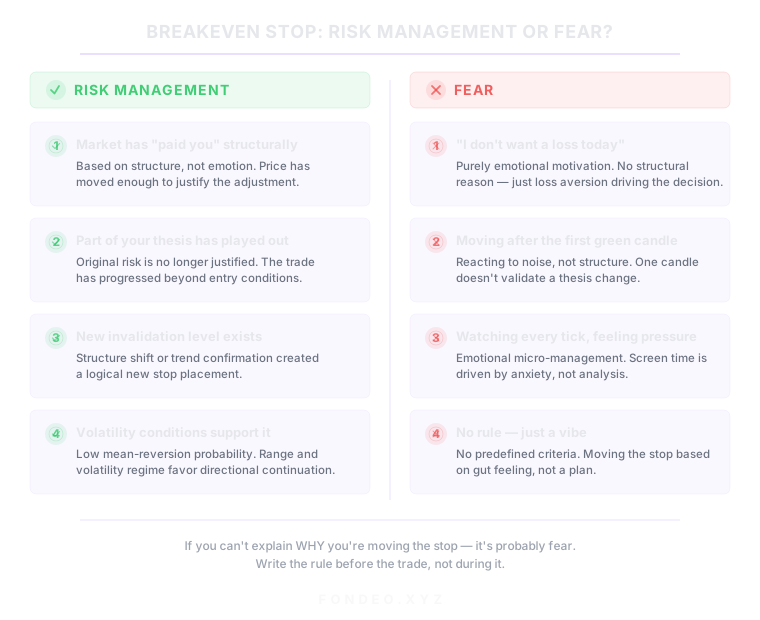
Use this as a quick decision framework.
Breakeven is usually risk management when:
- The market has “paid you” structurally (not emotionally).
- Part of your thesis has played out and your original risk is no longer justified.
- A new invalidation level exists (structure shift, trend continuation confirmation, etc.).
- Volatility/range conditions support it (less likely to mean-revert into your entry).
Breakeven is usually fear when:
- You move it because you “don’t want a loss today.”
- You move it after the first green candle.
- You move it because you’re watching every tick and feeling pressure.
- You move it with no rule—just a vibe.
In funded accounts, that “fear BE” often shows up right after a small losing streak—when you start trading the evaluation rules instead of trading your edge.
What You Should Optimize For as a Funded Trader (Not “Feeling Safe”)
A lot of traders accidentally optimize for comfort instead of expectancy.
In prop trading, you don’t get paid for avoiding losses. You get paid for:
- net profitability
- within drawdown limits
- with consistent risk management
So your real questions are:
- Does moving to BE increase my expectancy?
- Does it reduce drawdowns enough to matter?
- Does it keep me inside daily loss limits without cutting winners?
Expectancy reality check (fast)
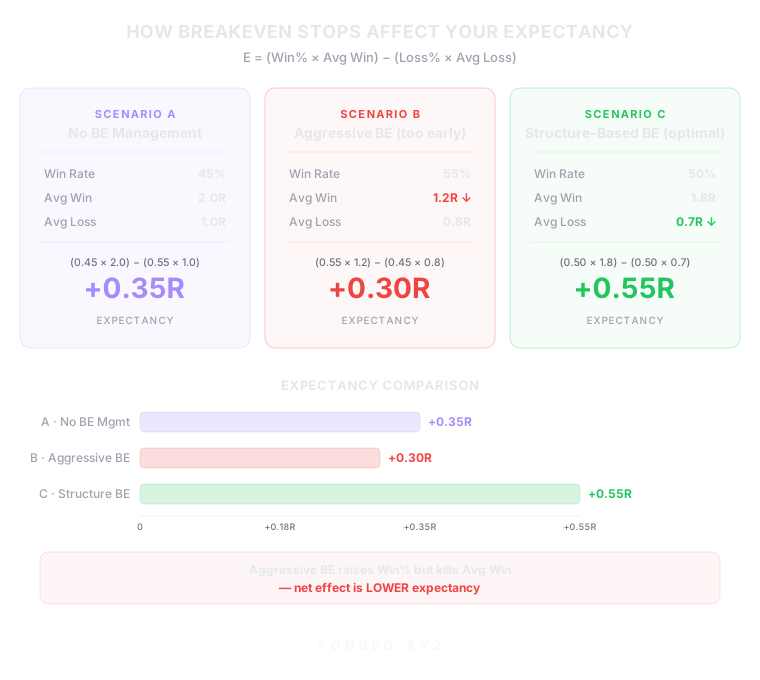
Expectancy is roughly:
E = (Win% × Avg Win) − (Loss% × Avg Loss)
Breakeven management often:
- raises Win% (scratches replace some losses)
- lowers Avg Win (some would-be winners get stopped at entry)
Sometimes that’s a great tradeoff.
But if your review shows many BE scratches later hit full TP, your “risk management” might be capping revenue.
Pro Tip: The market doesn’t reward comfort. It rewards correct process repeated.
A Step-by-Step Breakeven Plan You Can Actually Follow
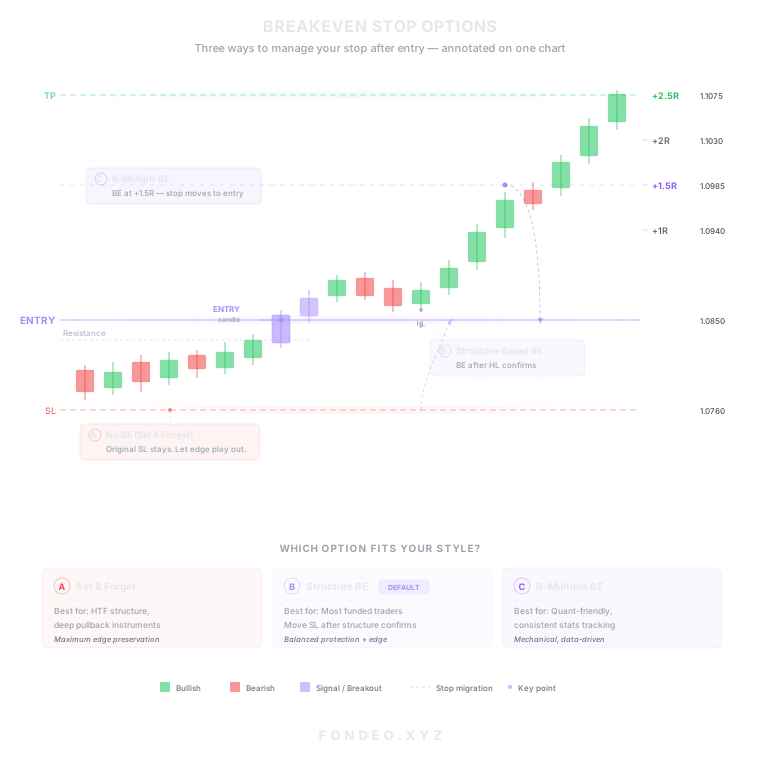
You’ll do better with one clear rule per setup than with “dynamic” management that changes with your mood.
Step 1: Define your trade type (so BE matches the job)
Different trades have different noise.
Label the trade before you enter:
- Scalp: small target, tight structure, quick invalidation
- Intraday: session move, medium target, moderate pullbacks
- Swing: multi-session, larger target, deeper retests
If you apply scalp-style BE rules to swing trades, you’ll get chopped out constantly.
Step 2: Choose one BE rule before entry
Pick one of these. Commit to it for that trade.
Option A — No BE (set-and-forget)
Best when:
- Your edge needs room through retests.
- The instrument routinely pulls back to entries.
- You’re trading higher-timeframe structure.
This is the “accept the risk” model:
- place the trade
- respect the stop
- let the edge play out
Pro Tip: If you’re constantly getting stopped at BE, you might not need a tighter stop—you might need a wider noise buffer or a later BE trigger.
Option B — Structure-based BE (best default for many funded traders)
Move to breakeven only after a structural event reduces the chance of a full stop.
Examples:
- break-and-close beyond a key level
- a higher low / lower high forms after the impulse
- a retest of broken structure holds
- your invalidation level logically shifts
Rule template (write this in your plan):
- “If price closes beyond X and then confirms Y, I move stop to BE.”
This keeps BE tied to market information—not nerves.
Option C — R-multiple BE (clean and quant-friendly)
Move to BE when price reaches a pre-defined multiple of your initial risk.
Common triggers:
- BE at +1R (conservative, lots of scratches — consider taking partials at +1R instead)
- BE at +1.5R (balanced)
- BE at +2R (gives winners room)
If your strategy targets 2R or more, consider:
- (optional) partial profit at +1R
- move stop to BE at +1.5R or after a structural confirmation
This is especially useful in prop trading because it produces consistent stats for review.
Step 3: Add a “one re-entry rule” to prevent emotional spirals
A common funded-trader failure pattern:
- get tagged at BE
- feel robbed
- chase the move into revenge trading
- overtrade into daily loss limits
Instead, formalize re-entry:
- One re-entry maximum
- Only if your original A+ trigger appears again
- Same risk or reduced risk (often smarter for funded trader account stability)
This prevents revenge trading while still letting you participate if the market simply did a normal retest.
Pro Tip: Re-entry is a privilege earned by rules—not a revenge trade wearing a suit.
Step 4: Backtest BE like a professional (3 columns that change everything)
Stop debating BE philosophically. Decide statistically.
For each trade in your trade review, record:
- Would TP have hit after BE? (Yes/No)
- MFE (Max Favorable Excursion) in R (how far price went your way)
- MAE (Max Adverse Excursion) in R (how close it came to your stop)
Then answer:
- At what MFE does moving to BE improve results?
- How often does price retest entry before continuation?
- Do winners require deeper pullbacks than your BE trigger allows?
This turns BE from a habit into a tested risk management rule.
Common Breakeven Mistakes That Quietly Blow Prop Accounts
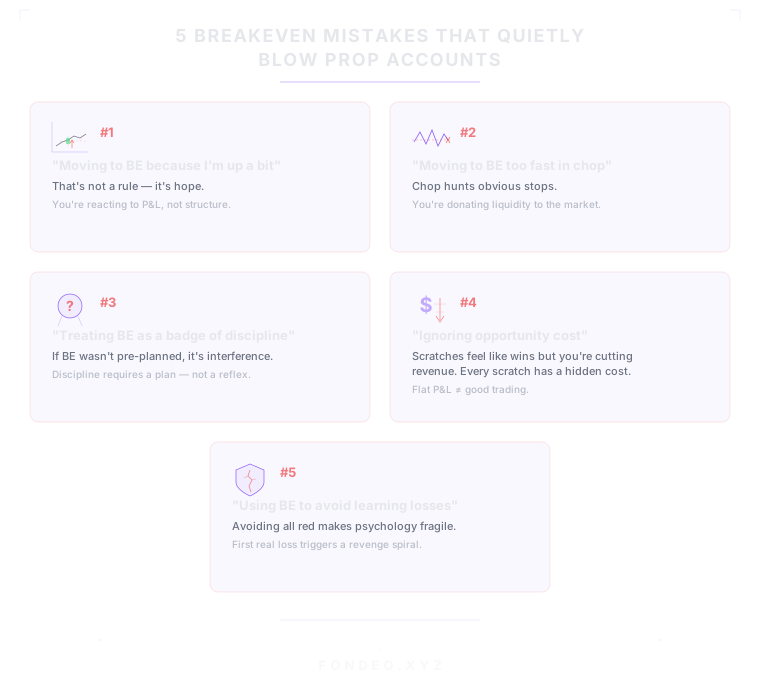
Moving to BE “because I’m up a bit”
That’s not a rule. It’s hope.
If typical pullback size is larger than your BE trigger, you’ll rack up scratches and wonder why you can’t scale.
Moving to BE too fast in choppy conditions
Chop hunts obvious stops.
Inside ranges, early BE is often just donating liquidity and shrinking your sample size of real winners.
Treating BE like a badge of discipline
Discipline is doing the plan.
If BE wasn’t pre-planned, it’s not discipline—it’s interference.
Ignoring opportunity cost
A scratch feels like a win because it’s “not a loss.”
But if a big percentage of scratches later hit full TP, you’re not protecting capital—you’re cutting revenue.
Using BE to avoid learning how to take losses
Losses are part of the business.
If you train yourself to avoid every red trade, your psychology gets fragile. Then the first real loss hits, and you’re more likely to:
- hesitate on the next entry
- widen stops randomly
- revenge trade to “get it back”
Pro Tip: The goal isn’t to avoid losses. The goal is to keep losses small enough for your edge to play out.
Habits That Make Breakeven Work Without Wrecking Your Edge
Breakeven problems are rarely about one trade. They’re about how you handle uncertainty.
Build a BE checklist (and require 3/4 to act)
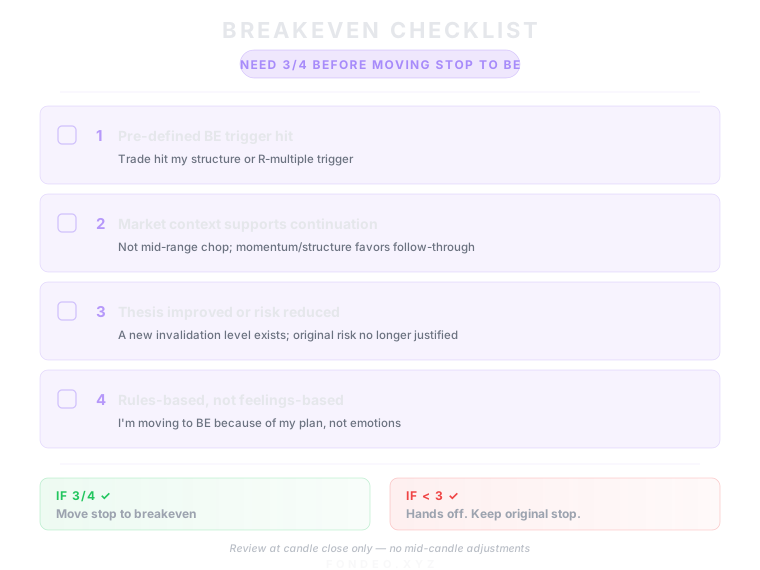
Print this. Keep it next to your screen.
Breakeven Checklist (need 3/4):
- [ ] Trade hit my pre-defined BE trigger (structure or R-multiple)
- [ ] Market context supports continuation (not mid-range chop)
- [ ] Thesis improved or risk reduced (a new invalidation exists)
- [ ] I’m moving to BE because of rules, not feelings
If you can’t tick 3/4, you don’t touch the stop.
Use “hands-off” time blocks
Most BE mistakes happen mid-candle.
Try this:
- only make management decisions at candle close (e.g., every 5m/15m)
- no stop adjustments mid-candle
This single habit cuts down emotional micromanagement.
Separate risk control from trade management
Funded traders often blend these.
- Risk control: position sizing, daily loss limits, max trades/day
- Trade management: BE, trailing, partials
If your sizing is correct at entry, you don’t need BE as a panic button.
Standardize position sizing (so BE stops being emotional)
Use a simple position-size calculator or risk tool.
A solid funded-trader baseline:
- fixed risk per trade (commonly 0.25%–1%, depending on prop rules)
- automatic sizing from stop distance
- no “gut feel” size changes after a win/loss
Consistent sizing improves both trading psychology and execution.
Adopt the “three outcomes” mindset
Be honest about what’s happening:
- full stop loss
- full take profit
- planned managed exit (including planned BE)
A scratch is only a “win” if it’s part of the tested plan.
Pro Tip: Amateurs focus on being right. Professionals focus on executing well.
Your Action Plan (Keep It Simple)
If you’ve been moving stops to breakeven out of fear, don’t beat yourself up. It’s a normal phase.
Now level up like a funded trader:
- Pick one setup you trade often.
- Pick one BE rule (No BE, Structure BE, or R-multiple BE).
- Trade it for 20 occurrences with zero improvisation.
- Review MFE/MAE and “would TP hit?” and adjust the rule based on data.
Consistency beats intensity. Every time.
If you’re ready to build a prop-trading process that tightens your risk management, strengthens your trading psychology, and helps you stay a funded trader long-term, start your journey at Fondeo.xyz.
Now go execute.
— Jake Salomon