
In Brief
- 10% months can happen—but “10% every month” is usually a trap. The deadline pushes you into forced trades, bigger size, and rule breaks.
- Prop trading is a risk management game first. If you control drawdown and trade a measurable edge, the returns become a byproduct.
- Your fastest path to becoming a funded trader is process, not pressure. Execute A+ setups, track expectancy in R, and review weekly.
You’ve probably done the math on your phone: “If I can just make 10% per month, I’m set.” It feels clean and motivating.
But prop trading doesn’t pay you for a monthly promise. It pays you for decisions—over and over—inside tight rules.
The market also doesn’t care about your calendar. Some months are smooth and trendy. Others are choppy, thin, or news-driven. In real trading, sometimes it’s 10%… and other times it’s 0.1%. A few months will be red. That’s normal.
The danger starts when you need a number by month-end. That pressure quietly changes your behavior:
- You start taking B setups because they “might work.”
- You trade more because you’re behind.
- You hold losers because you “can’t afford” to be wrong.
- You revenge trade because the drawdown feels personal.
This is exactly how good traders blow challenges, lose funded accounts, and damage their trading psychology.
Why Chasing “10% Every Month” Breaks Prop Traders
Let’s separate two different questions:
- Can you make 10% in a month? Yes.
- Can you sustainably target 10% every single month with normal risk? That’s where most traders get into trouble.
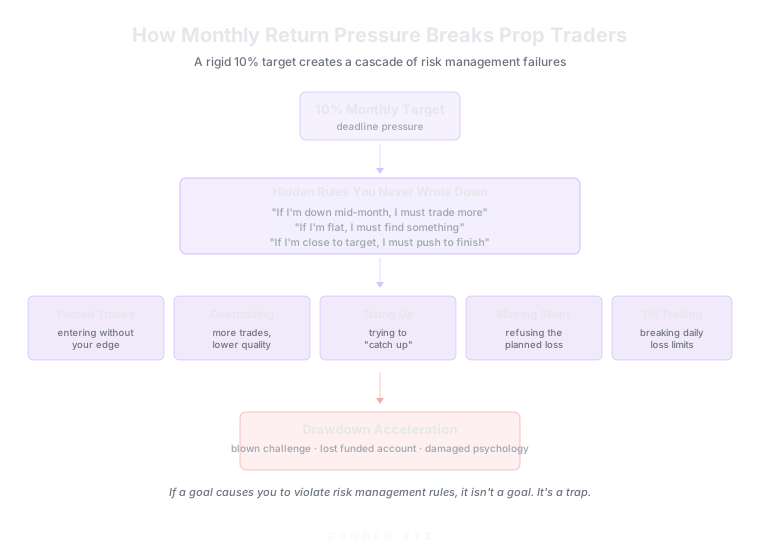
When you set a rigid monthly return target, you create hidden rules like:
- “If I’m down mid-month, I must trade more.”
- “If I’m flat, I must find something.”
- “If I’m close to the target, I must push to finish.”
That’s not a performance plan. It’s a pressure plan.
And pressure creates predictable prop-trader mistakes:
- Forced trades (entering without your edge)
- Overtrading (more trades, lower quality)
- Sizing up (trying to “catch up”)
- Moving stops (refusing to take the planned loss)
- Breaking daily loss limits (tilt trading)
Once that happens, drawdown accelerates—and drawdown is the one thing prop firms enforce aggressively.
Tip: If a goal causes you to violate your risk management rules, it isn’t a goal. It’s a trap.
What’s Actually Realistic for a Funded Trader?
Here’s a truth that saves careers: if you can average 2–5% per month over a long stretch while staying inside prop rules, you’re already performing at a high level.
That might not sound exciting compared to “10% monthly,” but it’s the difference between:
- a highlight reel (one great month)
- and a trading career (staying funded and scaling)
The part most traders underestimate is the risk required to force 10% every month.
To hit 10% consistently, many traders end up taking one (or more) of these shortcuts:
- Increasing risk per trade (see why you should stop risking 1% per trade under strict drawdown rules)
- Increasing trade frequency in mediocre conditions
- Holding positions longer than the strategy allows
- Letting losers run (because “it has to come back”)
Those shortcuts usually show up as bigger drawdowns. And even if you can handle big drawdown mathematically, you still have to handle it psychologically.
Ask yourself this like a pro:
- Can you execute calmly after a multi-day losing streak?
- Can you stop trading when you hit your limit?
- Can you take the next A+ setup without trying to “make it back”?
That’s funded trader behavior.
The Better Target: Expectancy + Risk Control
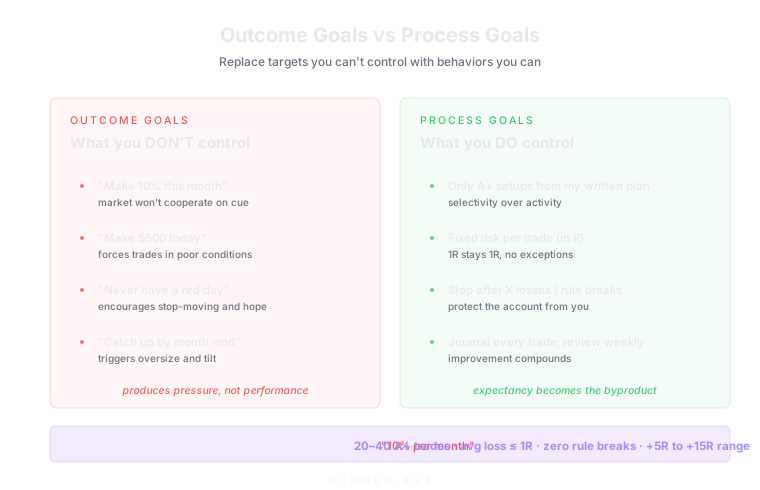
If you want a target that actually improves your results, shift from outcome goals to process-based goals.
Outcome goals (what you don’t control)
- “Make 10% this month.”
- “Make $500 today.”
- “Never have a red day.”
Process goals (what you do control)
- “Only take A+ setups that match my written plan.”
- “Risk a fixed amount per trade.”
- “Stop after X losses or Y rule violations.”
- “Journal every trade and review weekly.”
Now add the concept that makes process measurable: expectancy.
Expectancy in plain English
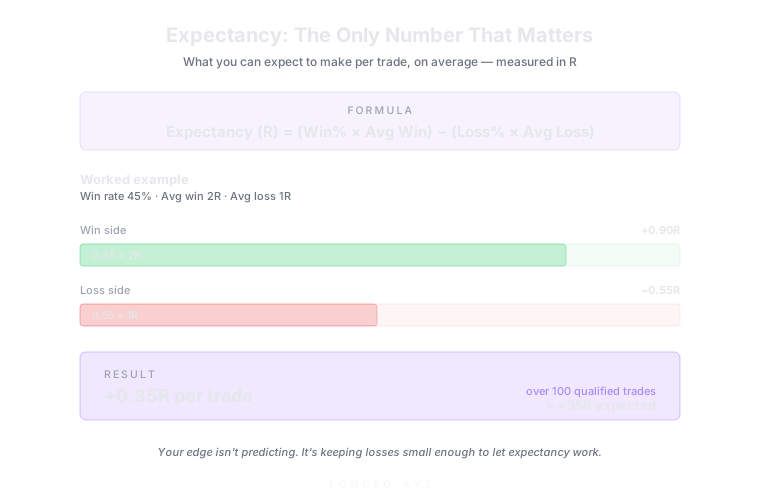
Expectancy tells you what you can expect to make per trade, on average, based on your win rate and your average win/loss size.
A simple formula:
- Expectancy (R) = (Win% × Avg Win in R) − (Loss% × Avg Loss in R)
Example:
- Win rate: 45%
- Average win: 2R
- Average loss: 1R
Expectancy = (0.45 × 2) − (0.55 × 1) = 0.90 − 0.55 = +0.35R per trade
That’s not hype. That’s math.
If your process produces +0.35R per trade over a meaningful sample, then your job is simple:
- Keep losses controlled (1R stays 1R)
- Keep winners within your plan—don’t cut winners early; use bracket orders and R multiples
- Take enough qualified trades for expectancy to show up, the same patient approach behind the framework for quitting your job to trade full-time
Tip: A funded trader’s advantage isn’t predicting. It’s keeping losses small enough to let expectancy work.
A Prop-Trader Goal System You Can Actually Follow
This is a practical framework you can run during a challenge, evaluation, or while staying funded.
Set survival rules before profit goals
Prop trading is a drawdown-constrained environment. Survival isn’t optional.
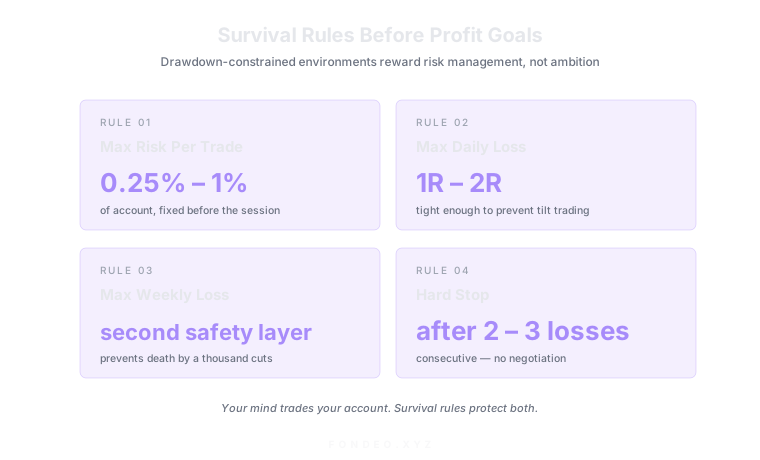
Start with these core risk management rules (adjust to your firm’s parameters):
- Max risk per trade: typically 0.25%–1%
- Max daily loss: often 1–2R (tight enough to prevent tilt)
- Max weekly loss: a second layer to prevent “death by a thousand cuts”
- Hard stop after consecutive losses: commonly 2–3 losses
This is how you protect your trading psychology. Your mind trades your account.
Define your A+ setup in writing (no vibes)
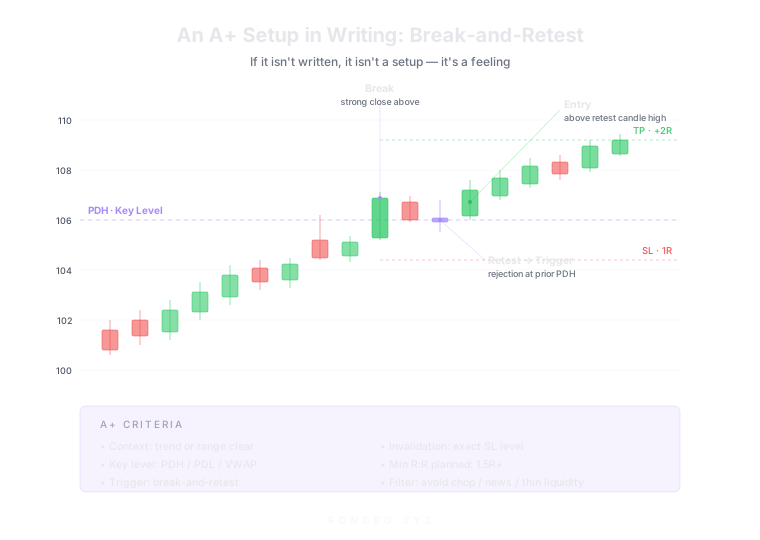
If it isn’t written, it isn’t a setup—it’s a feeling.
Your A+ criteria should be specific. Here’s an example checklist you can adapt:
- Market context: trend or range is clear (no messy structure)
- Key level: previous day high/low, major swing level, VWAP/anchor level (your choice—just be consistent)
- Trigger: break-and-retest, rejection, or a defined pattern you’ve tested
- Invalidation: exact level where the trade is wrong
- Minimum R:R: e.g., 1.5R+ planned
- Condition filter: avoid your “bad environment” (chop, low liquidity window, major news—whatever your data shows)
The prop-trading twist
If your prop firm has strict daily loss limits, your A+ filter must be even tighter. You can’t “trade through” chop like a discretionary gambler. You have to protect the account.
Tip: In a challenge, your edge isn’t activity. Your edge is selectivity.
Track in R, not dollars or percent
Percent and dollars mess with your head. R keeps you honest.
- 1R = your planned risk per trade
- A -1R loss is a normal business expense
- A +2R win pays for two clean losses
When you focus on R, you stop needing today to be “the day.” You start executing.
Replace “10% per month” with targets you control
Try these instead:
- A+ trades executed: 20–40 per month (depending on your strategy frequency)
- Average loss: keep it at ≤ 1R
- Rule breaks: target zero, or track them and reduce week over week
- R goal range: e.g., +5R to +15R per month
Why a range? Because market opportunity is not evenly distributed.
Some months are clean and you’ll outperform. Other months you’ll protect capital and stay ready.
That’s not inconsistency. That’s professionalism.
Trade “market availability,” not your need for action
Opportunity comes in waves.
- In clean conditions, your A+ setups show up and follow through.
- In chop, you’ll get faked out, chopped up, and death-by-a-thousand-cuts’d.
A simple rule that saves funded accounts:
- When conditions are low-quality, reduce size, reduce frequency, or sit out.
Sitting out is not passive. It’s risk management.
Tip: The best trade is often no trade—especially when your emotions want action.
The Most Common “10% Target” Mistakes (and How to Fix Them)
These are patterns that repeatedly fail challenges and destroy funded accounts.
Increasing size to “catch up”
You’re down a few percent, so you double risk to get it back faster.
Fix:
- Lock risk per trade before the session
- Only scale after a verified sample (e.g., 50+ trades) with stable execution
Turning B setups into “good enough”
You lower your standards because the month is ending.
Fix:
- Screenshot every entry
- If you can’t justify it in one sentence from your plan, it’s not A+
Treating drawdown as only a math problem
Most traders can handle less drawdown emotionally than they think. Once stress hits, discipline collapses.
Fix:
- Set a personal max drawdown tighter than the firm’s
- When hit, switch to sim or stop trading for the day—no negotiation
Confusing a good month with a good system
One outlier trend month can inflate confidence and hide bad habits—which is why a risk-managed plan for going full-time matters before you bank on these numbers.
Fix:
- Grade yourself on rule adherence and repeatability
- Judge performance over a meaningful sample size, not one month
The Weekly Routine That Makes You Fundable (and Keeps You Funded)
You don’t need more motivation. You need a repeatable routine.
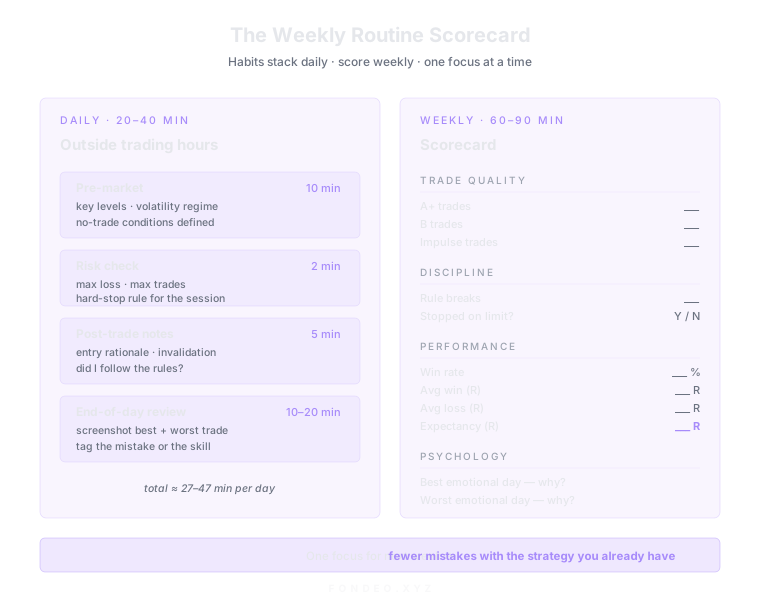
Daily (20–40 minutes outside trading)
- Pre-market (10 min): key levels, volatility regime, and your “no-trade” conditions
- Risk check (2 min): max loss for the day, max trades, and the hard stop rule
- Post-trade notes (5 min): why you entered, where invalidation was, did you follow rules?
- End-of-day review (10–20 min): screenshot best and worst trade; tag the mistake or the skill
Weekly review (60–90 minutes)
Build a simple scorecard:
- Trade quality
- A+ trades: __
- B trades: __
- Impulse trades: __
- Discipline
- Rule breaks: __
- Stopped on limit? (Yes/No)
- Performance metrics
- Win rate: __
- Avg win (R): __
- Avg loss (R): __
- Expectancy (R): __
- Trading psychology
- Best emotional day: why?
- Worst emotional day: why?
Then choose one focus for next week:
- “No trades during my chop window.”
- “Stop after 2 losses—no exceptions.”
- “Only trade with clean structure + level + trigger.”
One change at a time. That’s how habit-building works, and if you’re considering paid help to speed it up, weigh mentorship against a revenue-share arrangement first.
Tip: You don’t need a new strategy. You need fewer mistakes with the strategy you already have.
So, Is 10% Per Month Realistic?
Here’s the straight answer:
- 10% in a month? Yes, it can happen.
- 10% every month? For most prop traders, it’s not sustainable without increasing risk in a way that eventually creates major drawdown.
- A better target: build a process with positive expectancy and strict risk management that keeps you inside prop firm rules.
The irony is that when you stop chasing 10%, you often trade cleaner—and performance improves.
You’re no longer forcing trades. You’re selecting. You’re protecting capital. You’re becoming the kind of funded trader who can scale—and a structure like Fondeo’s subscription with auto-resets keeps one bad day from ending your month.
Implement this this week:
- Replace the monthly percent target with A+ trade count + R-based expectancy goals
- Tighten your risk management rules before you try to increase returns
- Commit to a weekly journal review so you improve on purpose
If you’re ready to approach prop trading like a professional—pass evaluations, build real funded trader habits, and protect your account when conditions are ugly—start your funded journey with Fondeo.xyz.
— Jake Salomon