Candles can feel like pseudo-science when you stare at them long enough. You see two doji-ish candles near the top of a push, long upper wicks smacking price down, and your brain starts writing a novel: failed breakout… trapped buyers… reversal incoming.
Sometimes you’re right.
But in prop trading, “sometimes right” isn’t good enough. A funded trader survives by executing a repeatable process under strict rules—daily loss limits, trailing drawdown, limited trade windows. Your job isn’t to predict the next candle. Your job is to manage risk and make clean decisions when the market gets uncertain.
Those 15m doji-ish toppers and repeated rejection wicks aren’t a magic sell signal. They’re a decision point. The market is basically saying: “Up here, it’s harder.” What you do next is where funded accounts are protected—or lost.
Tip: Multiple topping tails are the market showing you repeated rejection. Don’t translate that into “it must reverse.” Translate it into “my risk needs to be managed here.”
Doji-ish topping candles are information, not instructions
A doji-ish candle on the 15-minute chart usually means indecision—a temporary balance between buyers and sellers inside that bar.
When it prints after a strong bullish run and comes with long upper wicks (topping tails), it often means:
- Buyers attempted continuation higher
- Sellers defended that area
- Price was repeatedly accepted lower than the highs
Here’s the funded-trader framing: this is an auction signal, not a prediction.
A doji-ish topper can lead to:
- a pullback that refreshes the trend—best traded with a rules-based dip plan instead of guesswork,
- a tight range that chops your PnL,
- or a real reversal.
Your edge isn’t “naming the candle.” Your edge is having rules for what you do next.
The trap: candle storytelling (aka overfitting)
Candle storytelling sounds logical:
- “It got rejected five times, so it must go down.”
- “Two dojis at the top means exhaustion.”
- “Long wicks = smart money selling.”
Sometimes those narratives line up. Sometimes they don’t. Markets aren’t obligated to be neat.
In a funded account, the goal is to stop arguing with price and start responding to price with a consistent plan.
Tip: If your interpretation changes every time the next candle prints, you don’t have an edge—you have a story.
Context is the edge: don’t read the 15m in a vacuum
A 15-minute candle is a zoomed-in snapshot. Taken alone, it can mislead you.
A doji-ish topper means something completely different depending on where it forms:
- at a daily resistance level,
- in the middle of nowhere,
- after a trend day impulse,
- or during midday chop.
The “location” questions you should always ask
Before you do anything with that doji-ish candle, answer these:
-
Where are we on the higher timeframe (HTF)?
- Are we pushing into a daily/4H swing high?
- Are we breaking out of a weekly range?
- Are we extended from a 1H mean (EMA/VWAP/structure), making a pullback statistically normal?
-
What’s left above us?
- Prior swing highs (obvious liquidity)
- Prior day high / week high
- Range high / value area high
-
What’s the day doing right now?
- Trend day or range day?
- Early impulse or late-day grind?
- Major news/event risk soon?
If you can’t answer those, you’re not reading price action—you’re guessing.
A simple “context stack” that works in prop trading
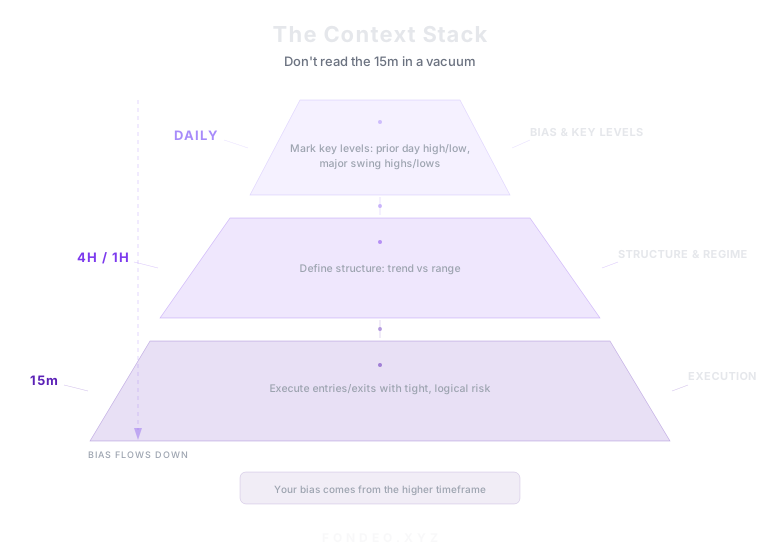
Keep it boring and repeatable:
- Daily: mark key levels (prior day high/low, major swing highs/lows)—and rank the levels that actually matter so your chart stays readable
- 4H/1H: define structure (trend vs range)
- 15m: execute entries/exits with tight, logical risk
When the 15m prints doji-ish toppers, you interpret them through this stack—so you don’t overreact to one candle. It's the same context-first logic you'd use to build a full prop trading strategy from scratch.
Tip: The 15m is for execution. Your bias comes from the higher timeframe.
The funded trader checklist for 15m doji toppers (entry + exit)
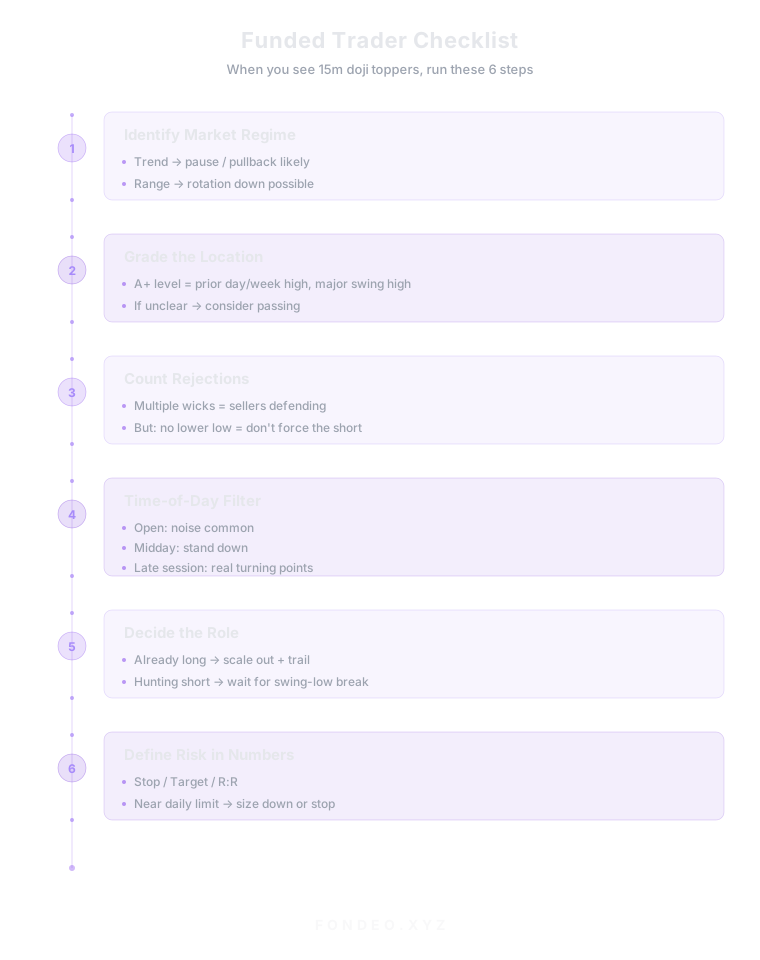
When you see repeated upper wicks / doji-ish candles at the top of a move, run this checklist in real time.
Step 1: Identify the market regime (trend, pullback, range)
On the 1H (or 4H if you swing intraday):
- Are we making higher highs and higher lows (uptrend)?
- Or are we overlapping and failing both sides (range/chop)?
If it’s trending: doji-ish toppers often mean pause/pullback, not instant reversal.
If it’s ranging: doji-ish toppers at range highs often mean rotation down—but only if structure confirms.
Tip: In trends, fading “topping candles” is often fighting the market. In ranges, it can be your cleanest setup.
Step 2: Grade the location (A+ or noise)
Doji-ish toppers matter most at obvious decision points:
- Prior day high / prior week high
- Major swing high (daily/4H)
- Big round number (instrument-dependent)
- Session high with multiple rejections
If you can’t explain the level in one sentence, it’s probably not a level.
Prop trading rule: when you’re uncertain, you don’t “try smaller” as a default—you first consider passing. Overtrading ambiguity is how traders fail evaluations.
Tip: Confusion is expensive in a funded account. If it’s not clear, protect your capital.
Step 3: Count rejections—but don’t worship them
Multiple topping tails mean sellers are defending.
But here’s the nuance that keeps you from overfitting:
- Rejection can be reversal… or it can be absorption before a breakout.
Instead of “how many smacks until it drops,” ask:
- Are lows holding higher each attempt? (bullish absorption)
- Are bounces getting weaker and rolling over? (bearish control)
- Are closes consistently off the highs? (sellers active)
If price keeps rejecting but can’t make a lower low, forcing a short is usually you trying to be early.
Step 4: Use time-of-day as a filter (huge for day trading)
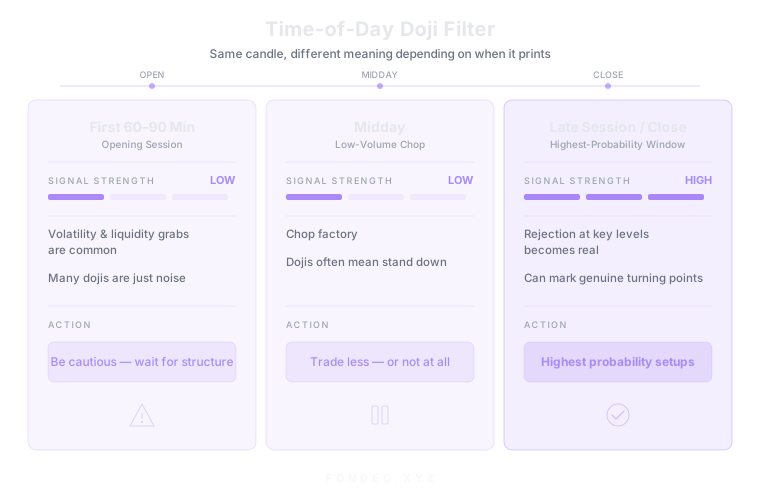
A 15m doji-ish topper means different things at different times:
- First 60–90 minutes: volatility and liquidity grabs are common. Many dojis are noise.
- Midday: chop factory. Dojis often mean “stand down.”
- Late session / close: rejection at key levels can become a real turning point.
In prop trading, one of the best decisions you can make is recognizing when conditions don’t pay.
Tip: When dojis start stacking during midday, your edge might be to trade less—or not at all.
Step 5: Decide what role the candle plays (manage a long vs hunt a short)
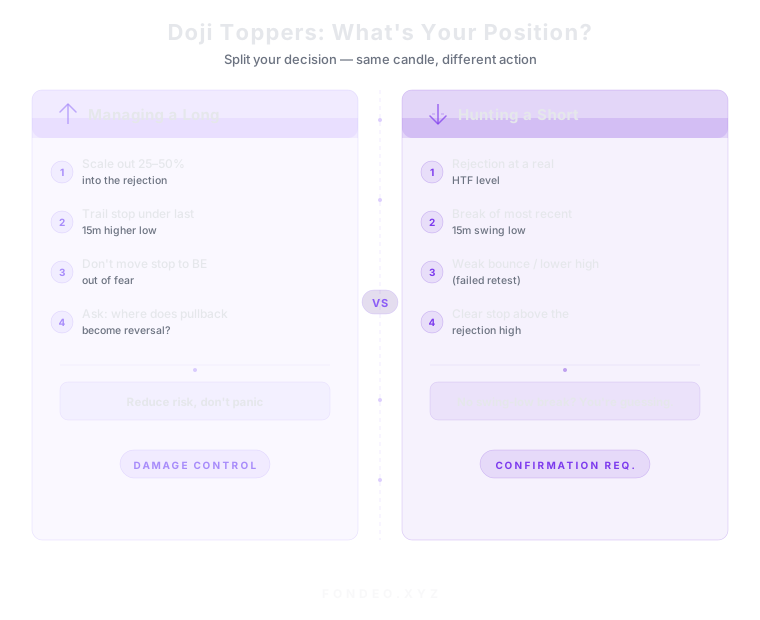
Most traders get hurt because they treat the same candle as:
- an exit signal and
- an entry signal.
Split your decision.
If you’re already long
Doji-ish toppers + upper wicks are usually a cue to reduce risk, not to panic.
Use this long-management checklist:
- Scale out into the rejection (pay yourself while liquidity is there)
- Move your stop to a structure level (not “under the doji”)—for example, under the last 15m higher low. Be careful not to move stops to breakeven out of fear
- If you’re extended, stop demanding continuation without a pullback
Ask one key question:
- Where does it stop being a pullback and start being a reversal?
That’s your thesis line. Your stop belongs near that line, adjusted for volatility.
Tip: Funded accounts reward damage control. If momentum is weakening, your job is to make your downside smaller.
If you’re hunting a short
A doji-ish topper is not enough. You need sellers to prove they can take control.
A clean, non-overfit short trigger:
- Rejection at a real HTF level
- Break of the most recent 15m swing low
- Weak bounce / lower high (failed retest)
- Clear stop above the rejection high
No swing-low break? You’re guessing.
Tip: Let structure break first. Wicks can reject five times and still grind higher.
Step 6: Define risk in numbers, not feelings
In prop trading, “this looks toppy” is not a risk plan.
Before you take any trade, define:
- Stop: where your idea is invalid—your invalidation level
- Target: next logical liquidity/level
- R:R: does it justify the attempt? (many funded traders require at least 1.5–2R for counter-trend)
- Daily risk status: are you near your daily loss limit or trailing drawdown?
Practical funded-trader risk management guidelines:
- Keep risk per trade consistent (commonly 0.25R–1R, depending on your rules and stats)—and understand why a blanket 1% per trade can backfire in losing streaks
- If you’re near a daily loss limit: size down or stop
- If the chart is unclear: no position is a position
Tip: If you can’t place a logical stop without risking too much, the trade is telling you to reduce size—or skip.
Common mistakes that blow prop accounts on “topping” candles
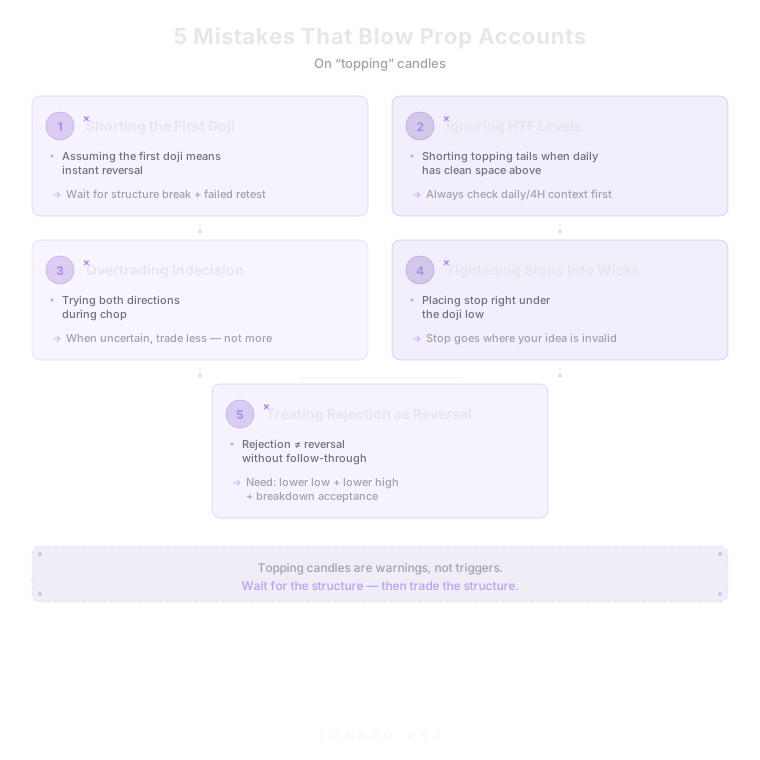
Shorting the first doji because it “should” reverse
In strong trends, the first doji is often just the market catching its breath.
Better: wait for a structure break + failed retest.
Ignoring higher timeframe levels
This creates the classic funded-trader pain:
- You short because you see topping tails… but the daily has clean space above.
- Or you refuse to exit a long at a major level because “it’s just a doji.”
Context turns fear into clarity.
Overtrading indecision
Dojis invite clicking:
- “Maybe it breaks up.”
- “Maybe it breaks down.”
- “Let me try both.”
That’s how traders churn into drawdown during chop—especially in evaluations.
Tip: When you see indecision, your default should be trade less, not trade more.
Tightening stops into the wick zone
If you tighten your stop right under the doji low, you often get wicked out… then price continues.
A stop goes where your idea is invalid, not where it feels emotionally safer.
Treating “rejection” as “reversal”
Rejection means sellers defended a level for now.
Reversal needs follow-through:
- lower low
- lower high
- breakdown acceptance / inability to reclaim the level
No structure change? Don’t force a reversal trade.
Build a repeatable habit: the 60-second doji debrief
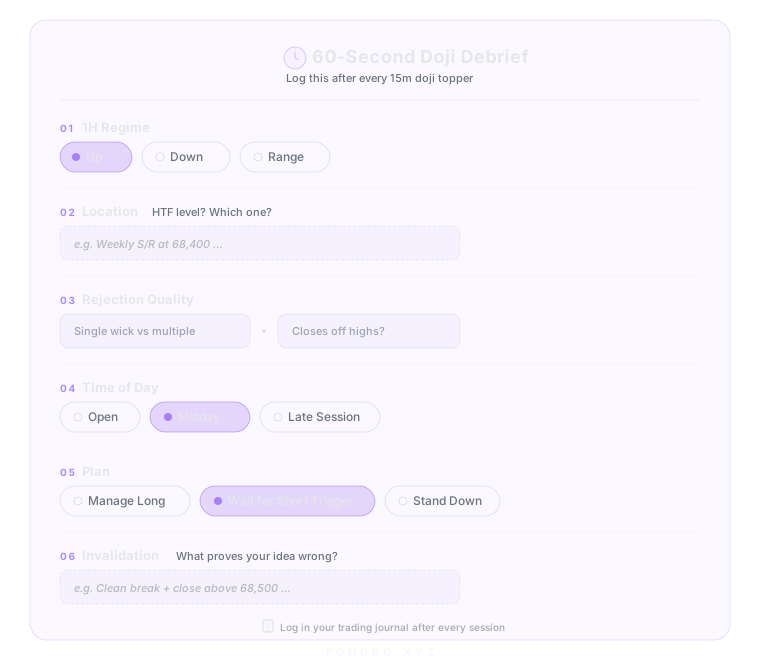
If you want consistent funded performance, you need to turn “I hate these wicks” into a calm routine.
After any 15m doji-ish topper, do this in 60 seconds
Log it in your trading journal:
- 1H regime: Up / Down / Range
- Location: HTF level? Which one?
- Rejection quality: single wick vs multiple; closes off highs?
- Time-of-day: open / midday / late session
- Plan: manage long / wait for short trigger / stand down
- Invalidation: what proves your idea wrong?
This small routine reduces impulsive trades and improves your pattern recognition without overfitting.
Tip: Journaling isn’t homework. It’s how you build your personal playbook—and stop repeating the same drawdown.
A real prop-trader scenario (no drama, just execution)
You’re long after a clean breakout. Price runs. You’re finally green. Then the 15m prints two doji-ish candles with long upper wicks. PnL flickers. Your mind starts bargaining.
This is where funded traders do something boring and effective:
- Acknowledge the signal: momentum is pausing and supply is present.
- Scale out 25–50% into the rejection.
- Trail the stop under the last 15m higher low (or a clear structure level).
- Let the market decide the rest.
If it rips, you still participate.
If it reverses, you still keep the win.
That’s how you trade within prop rules and build confidence that doesn’t depend on being right.
Your 15m doji topper action plan (save this)
Quick checklist
- [ ] What’s the daily/4H context? Any key level nearby?
- [ ] Is the 1H structure trending or ranging?
- [ ] Are we late in the move (extended) or early?
- [ ] Are rejections forming lower highs, or is price holding up?
- [ ] If long: scale out + trail under structure
- [ ] If short: wait for 15m swing-low break + failed retest
- [ ] Define stop + target + risk (no vibes)
- [ ] If unclear: do nothing (capital preservation is a strategy)
Tip: Your best funded-trader skill isn’t pattern recognition. It’s pattern response—running the same calm process every time.
Consistency beats perfection.
Run this checklist for the next 20 sessions and you’ll feel the difference: fewer impulse trades, cleaner exits, better risk control, and a mindset built for staying funded.
When you’re ready to apply this kind of process to a real prop trading path—one that rewards discipline, risk management, and strong trading psychology—visit Fondeo.xyz and start building your funded trader routine.
Trade clean. Protect your downside. Keep showing up.
— Jake Salomon