In Brief
- Revenue-share “coaching” is usually a misaligned deal for prop trading: it rewards short-term upside and ignores the downside risk you’re responsible for under firm rules.
- Vet any mentor like a prop risk manager: proof (prop-style stats), process (repeatable playbook), risk management (hard limits), and incentives (no dependency).
- Structure coaching professionally: flat fee or hourly + clear deliverables, plus boundaries that protect your trading psychology and your funded account.
You’ve probably lived some version of this.
You’re putting in work—journaling, reviewing, trying to stay consistent—while someone you know seems to be “crushing it.” Big percentage gains. Big confidence. Big opinions. You ask for feedback on your trades (not signals, not copy trading). Just guidance.
Then the conversation shifts from helpful to transactional:
“Give me 25% of your returns, and I’ll help you.”
That’s not just awkward. For prop trading, it can be dangerous—because it changes your incentives, your decision-making environment, and your risk behavior right when you need stability.
Let’s break this down like a funded trader who wants to stay funded.
Why “25% of your returns” is a red flag in prop trading
In prop trading, you already live inside a revenue-share model: you and the firm.
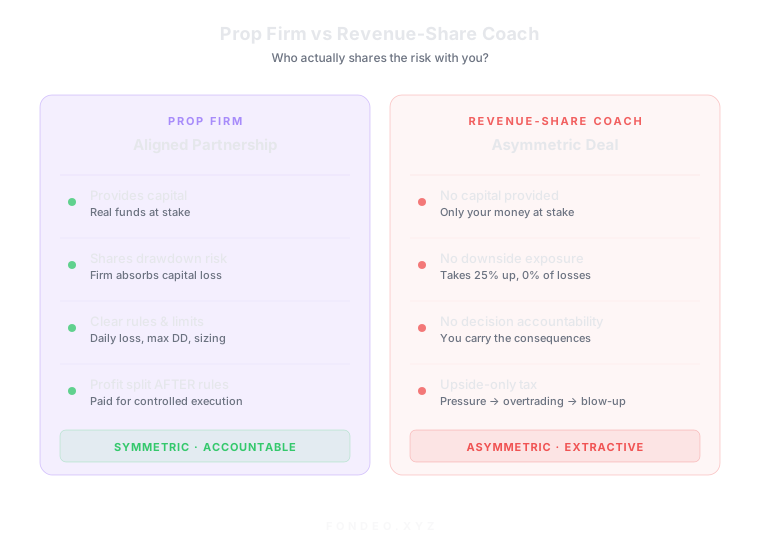
- The firm provides capital and rules.
- You provide execution, discipline, and risk control.
- You split profits after following the risk framework.
So when a “coach” asks for a slice of your returns, they’re effectively trying to become a second prop firm—without providing capital, without sharing drawdown risk, and often without being accountable for the decisions they influence.
Misaligned incentives can wreck your risk management
If someone gets paid only when you make money, they may (intentionally or not) steer you toward:
- taking more trades
- pushing size
- forcing performance into a short time window
- ignoring “no trade” days
That is the opposite of what keeps a funded trader alive.
Pro Tip: If a coaching arrangement increases urgency, it will almost always increase mistakes.
Upside-only deals aren’t coaching—they’re a tax
The simplest fairness test is this:
- If they want 25% of profits, do they take 25% of losses?
In real prop structures, you’re held to drawdown limits and daily loss limits. You don’t get to offload those consequences. If your “mentor” gets upside but none of the downside, the deal is asymmetric—and asymmetry breeds pressure.
Huge returns are not proof of skill (especially for funded traders)
A 500% year can happen with:
- extreme leverage
- concentrated bets
- survivorship bias (only showing the best account)—the kind of psychological trap the 12 rules to stop revenge trading are built to counter
- a risk profile that would fail most evaluations
Prop trading cares less about one loud number and more about how you got it:
- maximum drawdown
- losing streak behavior
- daily loss control
- average win vs average loss (R-multiples)
- consistency over time
If a trader can’t explain their drawdowns clearly, they’re not demonstrating mastery—you’re seeing a highlight reel.
Legal/ethical complexity is a hidden cost
Any time money changes hands for trading “advice,” you can drift into regulatory gray areas depending on jurisdiction and how services are marketed.
You don’t need to become an expert in financial regulation to make a smart decision here. The funded-trader takeaway is practical:
- Avoid unclear arrangements.
- Avoid handshake deals tied to performance.
- Avoid anything that makes you feel trapped or pressured.
The real issue: boundaries (and protecting your trading psychology)
A friend is allowed to value their time. A friend is allowed to say “I can’t coach you.”
But when someone turns your progress into their payday with a demand like 25%, it changes the relationship dynamics—and that leaks into your execution.
In prop trading, your mental environment is part of your edge. If you feel watched, judged, or obligated to “produce,” you’ll start trading to satisfy a person instead of following a plan.
Separate the roles—or don’t do it at all
If you want to keep the relationship intact, split it cleanly:
- Friend role: encouragement, general talk, no money attached.
- Mentor role: defined service, defined payment, defined deliverables.
Mixing them creates emotional leverage. And emotional leverage is how rules get broken.
Pro Tip: If you wouldn’t add risk to a trade “because of feelings,” don’t add financial complexity to mentorship because of feelings.
How to evaluate a trading coach like a prop firm risk manager
Use this filter question:
Will this person help you keep a funded account for 12+ months—not just pass a challenge on a hot streak?
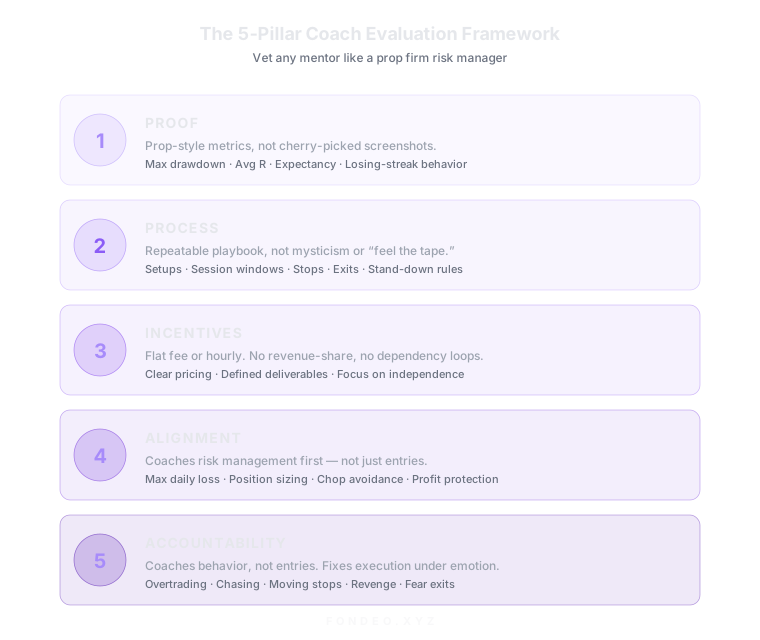
Proof: ask for prop-style metrics (not screenshots)
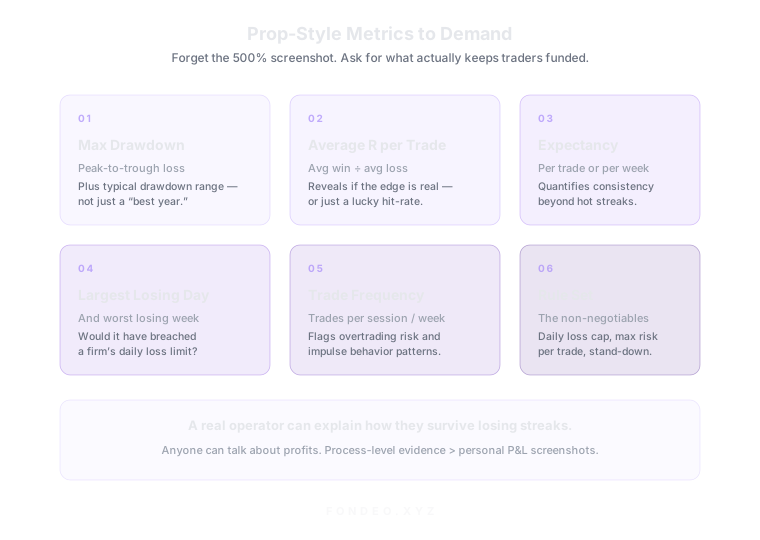
Forget cherry-picked wins. Ask for evidence that maps to funded trader requirements.
Here’s what matters:
- Maximum drawdown (peak-to-trough) and typical drawdown range
- Average R per trade (or avg win/avg loss)
- Expectancy (per trade or per week)
- Largest losing day / losing week
- Trade frequency (overtrading risk)
- Rule set they follow (daily loss limits, max risk per trade)
A legitimate coach doesn’t need to show you personal account numbers. But they should be able to show process-level evidence and explain how they manage drawdown.
Pro Tip: Anyone can talk about profits. A real operator can explain how they survive losing streaks.
Process: demand a repeatable playbook
A strong mentor can articulate their approach without mysticism—and can help you follow a risk-managed plan to go full-time instead of selling you theirs.
Look for clarity on:
- what markets they trade (and why)
- when they trade (session windows)
- what defines a valid setup (objective criteria)
- where the stop goes (and what invalidates the trade)
- how they take profits (targets, scaling, time stops)
- when they stand down (news, chop, daily loss limit)
- how they review and improve (journal process)
If you mostly hear:
- “just trust your instincts”
- “feel the tape”
- “size up when it looks right”
…that’s not prop-friendly coaching. It may work for them (maybe), but it won’t help you build a repeatable funded-trader routine—or weigh trading for a living against a prop-trading income plan.
Incentives: do they make money from trading—or from you?
Coaching isn’t automatically bad. But incentives matter.
Healthy signs:
- clear pricing (flat fee or hourly)
- clear deliverables (what you get)
- no pressure, no guilt
- a focus on making you independent
Risky signs:
- revenue-share demands
- urgency (“you’ll miss the move if you don’t start now”)
- vague promises (“I’ll make you profitable”)
- dependency loops (“you need my calls to trade”)—the opposite of the independence behind the framework for quitting your job to trade full-time
If the business model requires your continued confusion, that’s not mentorship. That’s retention.
Alignment: do they coach risk management first?
Prop firms fund your risk control.
A coach worth paying will emphasize:
- max daily loss and hard stop rules
- position sizing frameworks
- how to avoid revenge trading
- how to reduce trades in chop
- how to protect profits when you’re up
They’ll treat breakeven and “no trade” days as professional behavior, not weakness.
Accountability: do they coach behavior, not entries?
Most traders don’t fail because they can’t find setups. They fail because they can’t execute cleanly under emotion.
A prop-relevant coach helps you fix:
- overtrading after a win
- chasing after a loss
- moving stops
- taking profits early out of fear
- adding to losers
- ignoring your daily loss limit
Pro Tip: Great coaching makes you more consistent when you’re wrong—not just confident when you’re right.
The safest way to structure coaching (without risking your funded trader path)
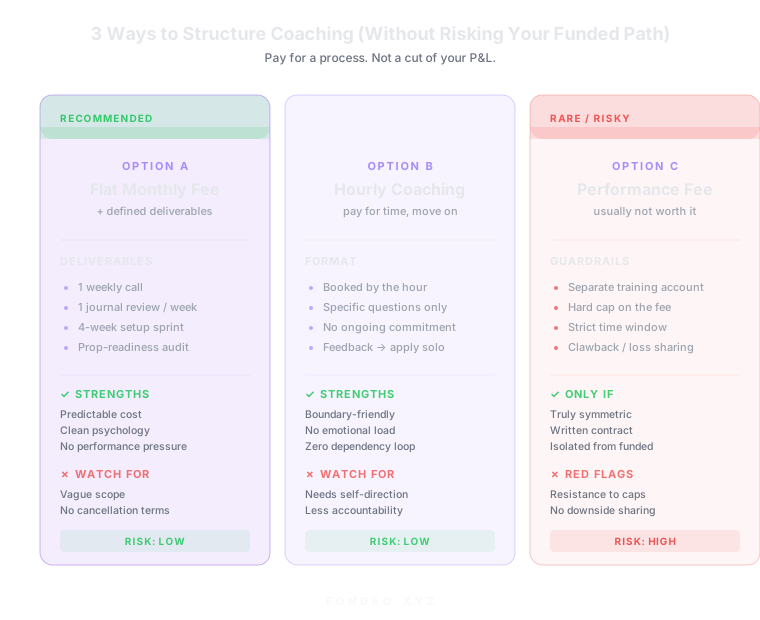
If you decide coaching is worth it, structure it like a professional service. Not like a side deal tied to your PnL.
Option A: Flat monthly fee + defined deliverables (best for most prop traders)
Examples:
- 1 weekly call + 1 journal review per week
- 4-week sprint focused on one setup + risk rules
- full “prop readiness” audit (plan + limits + routine)
Minimum deliverables to include:
- what you submit (journal, screenshots, stats)
- what you receive (written feedback + action steps)
- response times and scheduling
- cancellation terms
This keeps your trading psychology clean. You’re paying for a process—not trying to “perform” for someone.
Option B: Hourly coaching (simple, boundary-friendly)
Pay for time. Get feedback. Move on.
This reduces the emotional load and removes the “I deserve a cut of your wins” dynamic.
Option C: Performance fee (rare—usually not worth it)
If you ever consider a performance model, protect yourself:
- use a separate small training account
- cap the fee (hard maximum)
- define the exact calculation (net of fees/slippage)
- set a strict time window (e.g., 30 days)
- include downside symmetry (clawback/loss sharing) if it’s truly “partnership”
If any of that gets resisted, you’ve learned something important.
Pro Tip: If a coaching agreement makes you feel monitored, you will trade differently—and not in a good way.
Common mentorship mistakes that derail prop traders
These are the traps that show up again and again.
Mistake 1: Confusing extreme returns with a fundable risk profile
Prop firms don’t pay you for excitement. They pay you for controlled execution—the quiet kind behind boring consistency.
Ask this instead:
- What’s the risk of ruin?
- How often do they hit deep drawdowns?
- Would their approach survive strict daily loss limits?
Mistake 2: Buying signals when you need a system
Signals feel like relief.
But passing and staying funded requires:
- repeatable setups
- consistent sizing
- rule-based exits
- discipline under pressure
A coach should reduce dependency, not build it.
Mistake 3: Skipping due diligence because it’s “awkward”
If you can’t ask hard questions, you can’t protect your capital.
A professional coach expects:
- questions
- boundaries
- clarity
If they react with defensiveness, that’s information.
Mistake 4: Believing mentorship replaces screen time
Coaching can shorten the path. It can’t walk it for you.
You still need:
- journaling
- review
- deliberate practice
- repetition
Mistake 5: Outsourcing responsibility
If the coach becomes the reason you win, they become the reason you lose.
Your goal is ownership:
- “I followed my plan.”
- “I respected my daily loss limit.”
- “I executed my rules.”
That’s funded-trader identity—and it’s the same mindset you need when scaling a bigger funded account without giving the payout back.
A prop-trader habit system that makes any mentorship work better
Whether you hire someone or not, this system upgrades your results fast—because it forces clarity.
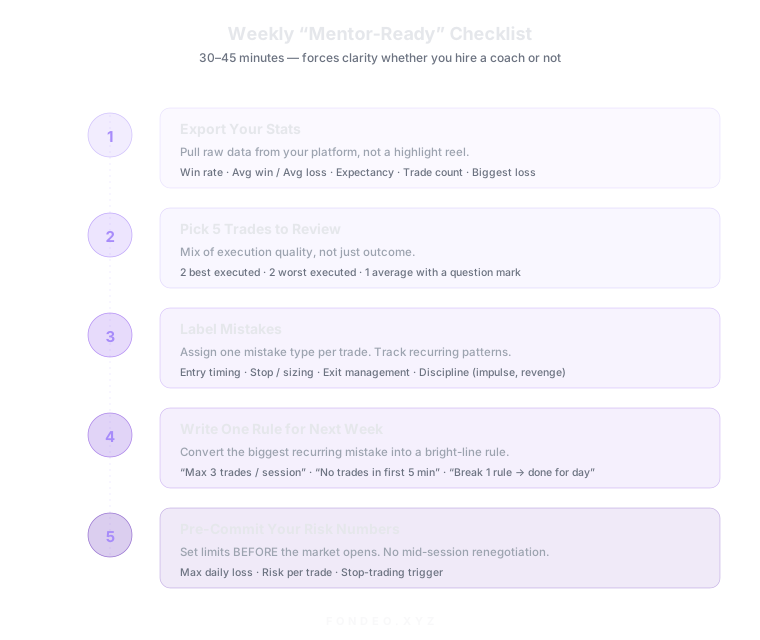
Weekly “mentor-ready” checklist (30–45 minutes)
-
Export your stats
- win rate
- average win / average loss
- expectancy (even a rough version)
- number of trades
- biggest loss
-
Pick 5 trades to review
- 2 best executed
- 2 worst executed
- 1 average trade with a question mark
-
Assign one mistake label per trade
- entry timing
- stop placement / sizing
- exit management
- discipline (impulse, boredom, revenge)
-
Write one rule for next week Examples:
- “Max 3 trades per session.”
- “No trades in the first 5 minutes.”
- “If I break one rule, I’m done for the day.”
-
Pre-commit your risk management numbers
- max daily loss
- risk per trade
- stop trading trigger
Pro Tip: Funded traders aren’t perfect. They’re consistent—and consistency is built before the market opens. Track it daily so coaching feedback has data, not vibes.
One line to anchor your trading psychology
Say this before your session:
“I don’t need to make money today. I need to trade well today. Money is the side effect.”
It pulls you out of outcome-chasing and back into execution—exactly where prop traders win.
What to say if someone asks for 25% of your returns
Use a calm, professional script. No drama. No negotiation spiral.
“I respect your time and skill. But a percentage of my returns doesn’t work for me—especially with prop trading rules. If you want to coach, I’m open to an hourly or monthly structure with clear deliverables. If not, totally fine—we’ll keep it as friends.”
Then stop talking. Let them respond.
If they push, guilt, or escalate, that’s your answer.
Final thought: your sustainability matters more than someone else’s story
If you’re up 25% on the year while staying controlled, you’re doing something many traders never figure out:
- you’re surviving
- you’re learning
- you’re building a base
That’s how funded traders are built.
This week, do three things:
- Audit your inputs (friends, paid groups, creators). Remove anything that creates urgency or dependency.
- Lock in one risk management rule you will not break (daily loss limit or max trades).
- Start the weekly checklist above and keep it for 4 straight weeks.
When you’re ready to turn that consistency into a real funded-trader journey—structure, rules, and a trader-first environment—go do it with Fondeo.xyz.
Stay disciplined,
Jake Salomon