You’ve been there: the chart looks clean, the level is obvious, and you’re sure it’s about to go. You buy the breakout… and a few candles later you’re staring at a red position, wondering how the market can be so “rigged.”
That cycle is exactly how capable traders fail prop trading evaluations. Not because you don’t understand entries, but because you’re taking too many low-quality breakouts—the ones that feel exciting and behave like background noise.
This guide gives you a practical, prop-trading-specific solution: a volume-qualified breakout filter that helps you trade less, trade cleaner, and protect what matters most in a challenge—eligibility.
In Brief
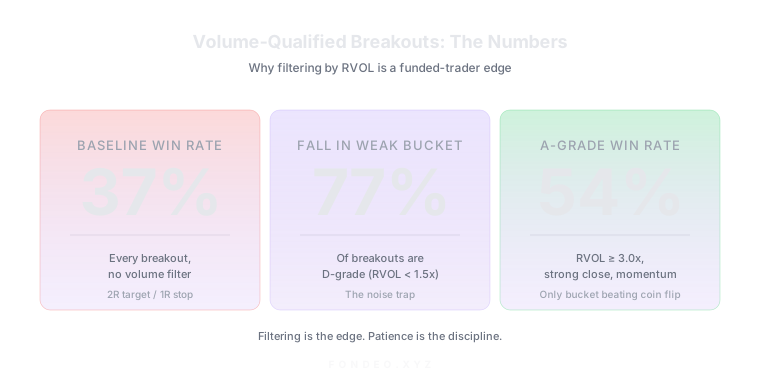
- Most breakouts are noise. The baseline win rate sits around 37%, and roughly 77% of breakouts fall into the weakest volume bucket.
- Volume quality changes the game. “A-grade” breakouts (around 3x+ RVOL plus strong price action) are the only group that consistently beats the coin flip.
- Patience is a funded trader edge. Higher volume thresholds create fewer signals — but better expectancy, fewer emotional errors, and smoother drawdown management. This filter slots into a complete prop trading strategy you build from scratch.
Why Most Breakouts Fail (And Why That’s Good News for a Funded Trader)
Here’s the uncomfortable truth: most breakouts fail.
Across thousands of daily breakout events in large, liquid stocks, using a simple ruleset—breakout on a close above a prior range, managed with a 2R target and 1R stop over a limited holding window—the overall win rate lands around 37%.
That sounds harsh. But it’s actually useful.
If you trade every breakout you see, you’re basically signing up for randomness. In prop trading, randomness doesn’t just hurt your PnL—it threatens your account rules:
- Daily loss limits punish chop days.
- Max drawdown rules punish death-by-a-thousand-cuts.
- Consistency rules punish “one big day, three messy days.”
So the real question becomes: how do you stop trading breakouts that are statistically more likely to fail?
Filtering is the edge.
Prop trader principle: Your job in an evaluation isn’t to prove you can trade a lot. It’s to prove you can protect capital while executing a repeatable process.
The Volume-Qualified Breakout Concept (A–D Grading)
Most breakout filters are vague: “volume is above average.” The problem is that above average still includes a huge number of mediocre signals.
A stronger approach is to grade breakouts using:
- Relative volume (RVOL) — participation
- Close quality — who won the breakout candle
- Short-term momentum — whether the breakout aligns with recent push
This gives you a clean “quality score” you can execute under pressure.
The breakout trigger (objective and testable)
Keep the breakout definition simple so your rules don’t drift.
- Breakout = daily close above the highest high of the prior 20 bars
This matters for prop trading because unclear triggers lead to discretionary overrides (“this looks like a breakout”), and discretionary overrides lead to broken risk rules.
The risk framework (built for evaluations)
A funded trader strategy isn’t just entries—it’s survival.
- Stop: 1R risk defined by the setup (commonly the breakout candle low on daily, or a structure-based invalidation if you have strict rules)
- Target: 2R (R-multiple targets and bracket orders keep trade management mechanical)
- Time stop: exit after ~20 bars if neither stop nor target hits (prevents slow bleed positions)
Now layer the grading on top.
The A–D Breakout Grades (RVOL + Price Action + Momentum)
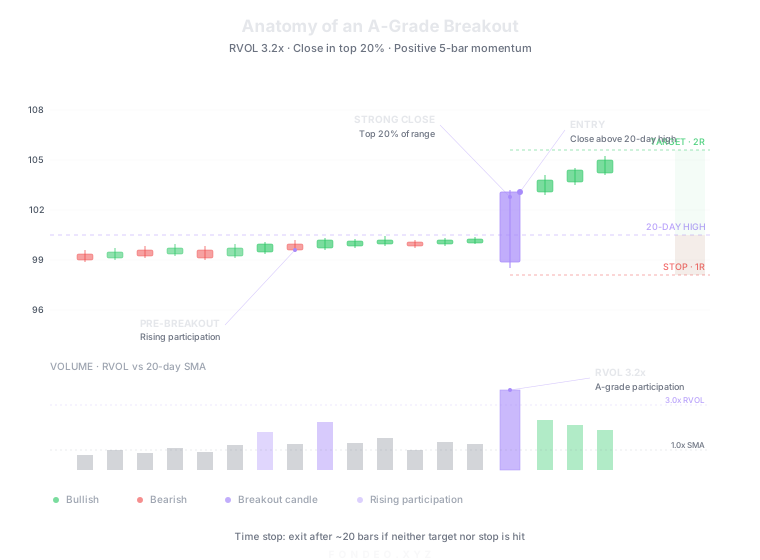
Use these inputs consistently:
- RVOL = current volume / 20-day SMA(volume)
- Close quality: where the candle closes inside its range
- Momentum: is the close above the close 5 bars ago?
A-grade breakout
- RVOL: ~3.0x+
- Close: top 20% of the candle range
- Momentum: positive (close > close 5 bars ago)
B-grade breakout
- RVOL: ~2.0–3.0x
- Supportive close and momentum (not perfect, but clearly not weak)
C-grade breakout
- RVOL: ~1.5–2.0x
- Borderline participation
D-grade breakout
- RVOL: below 1.5x
- The “breakout-shaped object” that often trades like noise
What the Numbers Say (And What You Should Do With Them)
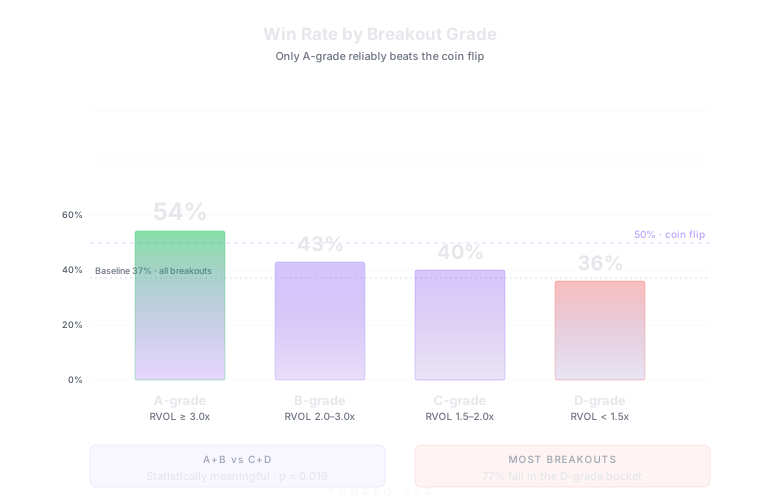
When you sort breakouts by this A–D quality scale, the win rates separate:
- Overall baseline: ~37% win rate
- A-grade: ~54% win rate
- B-grade: ~43%
- C-grade: ~40%
- D-grade: ~36%
Two things matter for your execution:
- A-grade is the only bucket reliably above a coin flip.
- Most breakouts are D-grade. Roughly 77% fall under the weak-volume threshold.
If you’re trading breakouts without a filter, you’re mostly trading the lowest-quality category.
And yes—the difference is real enough to matter. Grouping higher-quality signals (A+B) vs lower-quality (C+D) shows a statistically meaningful separation (p ≈ 0.019).
Takeaway: Your results won’t change because you “try harder.” They change when you stop feeding your account the worst signals.
Picking a Volume Threshold: Fewer Trades, Better Quality
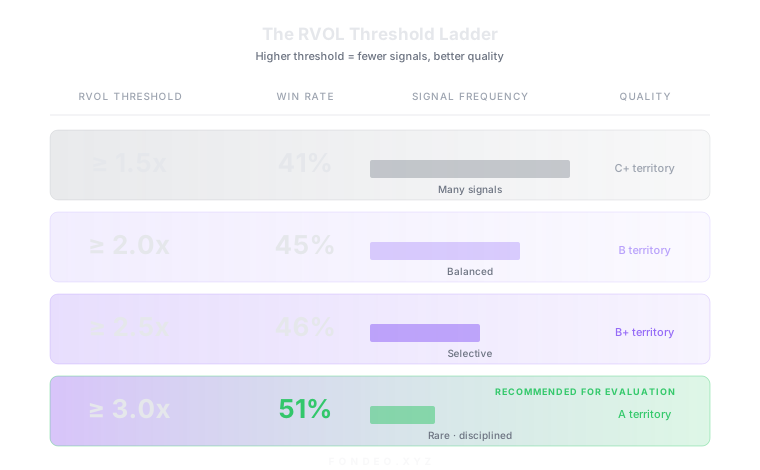
If you prefer a simpler approach than A–D grading, you can use raw RVOL thresholds.
- RVOL ≥ 1.5x: ~41% win rate (more signals)
- RVOL ≥ 2.0x: ~45%
- RVOL ≥ 2.5x: ~46%
- RVOL ≥ 3.0x: ~51% (fewer signals, higher quality)
Higher thresholds reduce opportunities, but they typically increase signal quality. That tradeoff is exactly what most funded traders need.
What I recommend for prop trading
- Evaluation phase: start with A/B only (or RVOL ≥ 2.0x, ideally 3.0x if you overtrade)
- Funded phase: you can expand selectively, but only after you prove you can stay disciplined and profitable without needing constant action
Pro Tip: If you struggle with overtrading, set your filter to RVOL ≥ 3.0x for 2–3 weeks. The lack of signals is the training.
Why This Filter Protects Funded Accounts Specifically
A personal account can tolerate more “meh” trades if your size is small and your timeline is long.
Prop trading is different. Your account is constrained by rules, and low-quality breakouts tend to create the exact failure mode that violates those rules: repeated small losses and impulsive re-entries.
A volume-qualified filter protects you in three ways:
It reduces daily emotional drawdown
Noise trades don’t just cost money. They cost composure — especially when a regime change quietly breaks your edge and failed breakouts start to cluster.
When you cut D-grade breakouts, you cut:
- impulsive second attempts,
- revenge trades,
- size bumps to “make it back,”
- and sloppy late entries.
It makes “no trade” a real strategy
In an evaluation, not trading is a decision.
You’re not paid to be active. You’re paid to be consistent.
It forces you to play for eligibility
If you can’t stay inside drawdown limits, the best strategy in the world doesn’t matter.
Pro Tip: Your #1 edge in a prop evaluation is staying eligible. Filtering is eligibility management.
How to Apply the Filter (Step-by-Step)
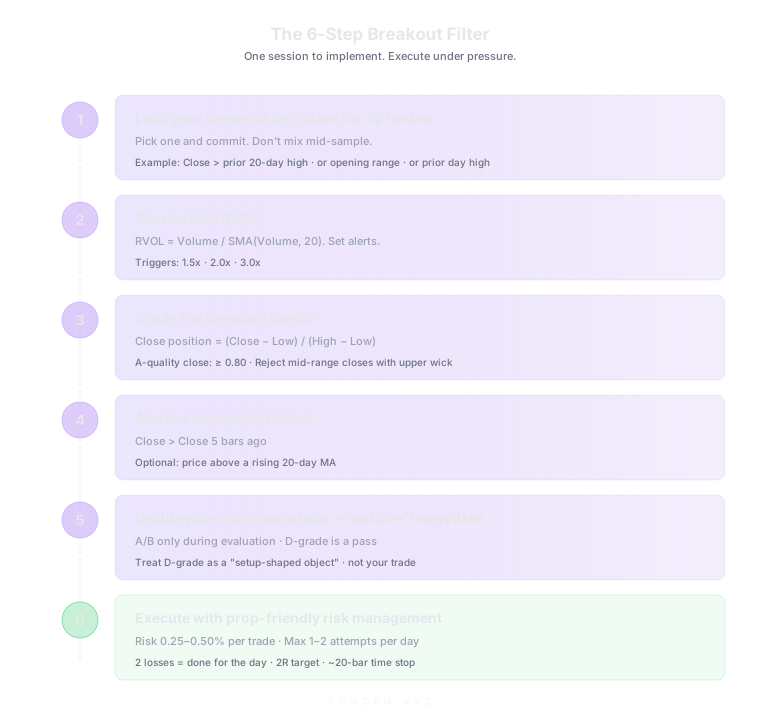
You can implement this in one session without turning your chart into a science project.
Step 1: Lock your breakout definition for 30 trades
Pick one and commit.
Daily example:
- Close > prior 20-day high
Intraday adaptation (same concept):
- Close > last N-bar high
- Close > opening range high
- Close > prior day high
Don’t mix them mid-sample. If you keep changing the trigger, you’ll never know what’s working.
Step 2: Standardize RVOL
Use:
- RVOL = Volume / SMA(Volume, 20)
Set alerts at:
- 1.5x
- 2.0x
- 3.0x
Step 3: Grade the breakout candle (this is where the edge gets real)
Many traders see high RVOL and stop thinking. Don’t.
Use a simple close-quality check:
- Close position = (Close − Low) / (High − Low)
Guidelines:
- A-quality close: ≥ 0.80
- Avoid candles that break out but close mid-range with a large upper wick (often two-sided auction)
Step 4: Add the momentum check
Keep it simple:
- Momentum positive: Close > Close(5 bars ago)
Optional (only if it helps you say “no”):
- price above a rising 20-day MA
- 5-bar return is positive
Step 5: Decide your minimum grade (and don’t negotiate)
Practical rule:
- A/B only when you’re building discipline or in evaluation
- Consider C only if you have strong confluence and proven control
- D is a pass
If it’s D-grade, treat it like a “setup-shaped object.” It’s not your trade.
Step 6: Execute with prop-friendly risk management
This is where funded traders separate from emotional traders.
Rules that keep you alive:
- Risk 0.25%–0.50% per trade during evaluation (learn why in our guide on position sizing for prop traders)
- Max 1–2 breakout attempts per day/session
- If you take 2 losses, you’re done for the day
You’re not limiting profit. You’re limiting the behavior that breaks accounts.
Pro Tip: The account killer usually isn’t one loss. It’s the cluster of losses from forcing marginal setups.
The “Circular Volume” Critique (And the Pro-Level Fix)
A smart critique is: “Isn’t volume on the breakout candle just because of the breakout?”
Sometimes, yes. Breakout-bar volume is often confirmation.
So here’s the pro adjustment: look for participation building before the breakout, not only on the breakout candle.
Simple “pre-breakout participation” rules
Pick one (don’t stack all of them):
- In the last 5 bars before breakout, at least 1–2 bars had above-average volume
- RVOL is rising into breakout: today’s RVOL > yesterday’s RVOL
The goal isn’t perfection. It’s avoiding the most obvious trap: breakouts that come from dead volume and exist mainly to grab liquidity.
Pro Tip: Breakouts that emerge after rising participation tend to follow through more cleanly than breakouts that appear out of nowhere.
“If Breakouts Fail, Should You Just Fade Them?”
It’s tempting: if the baseline win rate is ~37%, doesn’t fading breakouts become easy money?
Not automatically.
Failed breakouts can be profitable, but fading introduces new problems:
- price often chops before resolving (multiple stop-outs)
- invalidation levels are harder to define
- fading too early is guessing, not trading
A prop-safe failed-breakout playbook (if you explore it)
- Focus on D-grade (or weak C) breakouts
- Wait for confirmation of failure (close back inside the range)
- Define tight invalidation: reclaim breakout level + strong close
- Trade smaller size than your continuation trades
Still, if you’re in a challenge, master A/B continuation first. You want clean execution before you add a messier model.
Common Mistakes That Ruin an Otherwise Strong Filter
Treating RVOL like a magic number
News, earnings, rebalances—volume context shifts. RVOL is a filter, not a guarantee.
Ignoring candle structure
A 3x RVOL candle with a nasty wick and weak close can be pure two-sided auction.
If you only improve one thing: demand a strong close.
Taking trades because you’re bored
Boredom is one of the most expensive emotions in prop trading. If your filter reduces trades, your mind will try to negotiate.
Don’t.
Changing rules after two losses
A-grade setups are rare by definition. If you require 3x RVOL, you won’t trade every day.
That’s normal.
Pro Tip: Consistency isn’t doing the same thing when it’s easy. It’s doing the same thing when you’re frustrated.
Habit-Building: Become the Trader Who Only Takes A/B Setups
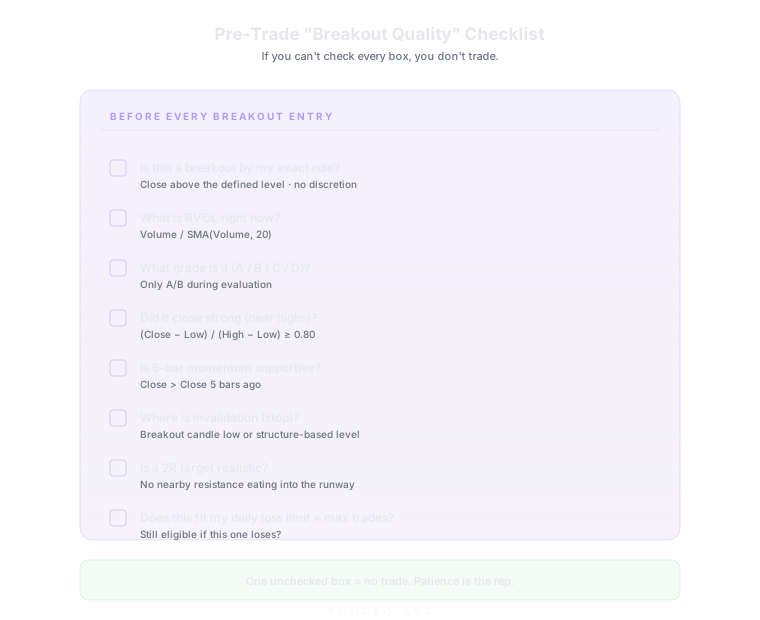
The filter is simple. The hard part is becoming the person who follows it.
Your pre-trade “Breakout Quality” checklist
Use this before every breakout entry:
- [ ] Is this a breakout by my exact rule?
- [ ] What is RVOL?
- [ ] What grade is it (A/B/C/D)?
- [ ] Did it close strong (near highs)?
- [ ] Is 5-bar momentum supportive?
- [ ] Where is invalidation (stop)?
- [ ] Is a 2R target realistic?
- [ ] Does this fit my daily loss limits and max trades?
If you can’t check the boxes, you don’t trade.
The “patience reps” protocol (2 weeks)
- Only take A/B-grade setups
- If you take a C/D, journal it as a rule break even if it wins
- Weekly review:
- How many trades did you avoid?
- How much drawdown did you avoid?
- Did your decision-making improve?
That’s how you rewire your trading psychology: you teach yourself that missing trades is safe.
What to journal (keep it simple)
After each trade:
- Grade (A/B/C/D)
- RVOL number
- Close quality (strong/medium/weak)
- Result (R multiple)
- Rule-followed? (yes/no)
After 30 trades, you’ll have data on your behavior—not just market behavior.
Add Confluence Carefully (Only If It Helps You Say “No”)
Once you can execute the core filter, you can add one layer of confluence without turning your strategy into a Christmas tree.
Confluence that pairs well with volume-qualified breakouts:
- market regime (index trending vs choppy) — understanding trend reversals vs. continuation helps you read structure before the breakout
- key levels (major weekly/daily levels, not random lines)
- participation tools you already understand (order flow for futures, positioning concepts if you have rules)
One rule keeps you honest:
- Only add a filter if it helps you reject more trades than it approves.
That’s how you stay selective—and stay funded.
Your Next Action (Do This This Week)
Commit to one change: stop trading D-grade breakouts.
- Add RVOL to your chart
- Set alerts for 2x and 3x
- Use the checklist
- Cap yourself at 1–2 breakout attempts per session
You’re not aiming for heroic days. You’re building a repeatable process that survives drawdown rules.
If you’re ready to apply disciplined risk management, sharpen your trading psychology, and build the habits that keep you funded, start your next step with Fondeo.xyz.
Trade safe. Stay selective.
— Jake Salomon