
You’re not broken. Your strategy didn’t “betray” you. You just ran into the part of trading that turns confident weeks into account-threatening weeks:
market regimes change.
One stretch you’re buying -2σ VWAP deviations, catching clean rotations back toward VWAP, and it feels repeatable. Then volatility expands, price stops respecting your bands, and the exact same entries become a slow-motion drawdown.
This is the fork in the road for every prop trading and futures trader:
- Amateur path: widen bands, increase size, take more trades, and hope the market comes back to your rules.
- Professional path: recognize regime change early, hit the kill switch, and return with a plan.
This article is the playbook I want you using as a funded trader—because in prop trading, risk management is the strategy that keeps you in the game long enough to prove your edge. It plugs straight into the prop trading strategy you build from scratch.
Anchor idea: The days you don’t trade are often the days that keep you funded.
Why VWAP Mean Reversion Works… Until It Doesn’t
VWAP mean reversion has real logic when the market is behaving in a balanced way:
- VWAP is a widely watched “fair value” benchmark.
- On range-bound sessions, price often oscillates around VWAP.
- Deviations can mark inventory extremes where responsive buyers/sellers show up.
In that environment, buying -2σ and scaling out into -1σ and 0 can be incredibly consistent.
The trap is thinking the band causes the reversal.
VWAP standard deviation bands don’t create support/resistance. They measure dispersion. And dispersion can expand hard.
When the market shifts into an expansion / trend regime, yesterday’s “extreme” (-2σ) can become today’s normal. Price can walk the band, push to -3σ, then -4σ, and keep going—without giving you the rotation your risk model depends on.
Practical reminder: Treat VWAP deviations like a thermometer, not a wall.
The Two Regimes That Matter Most: Balanced vs. Expanding
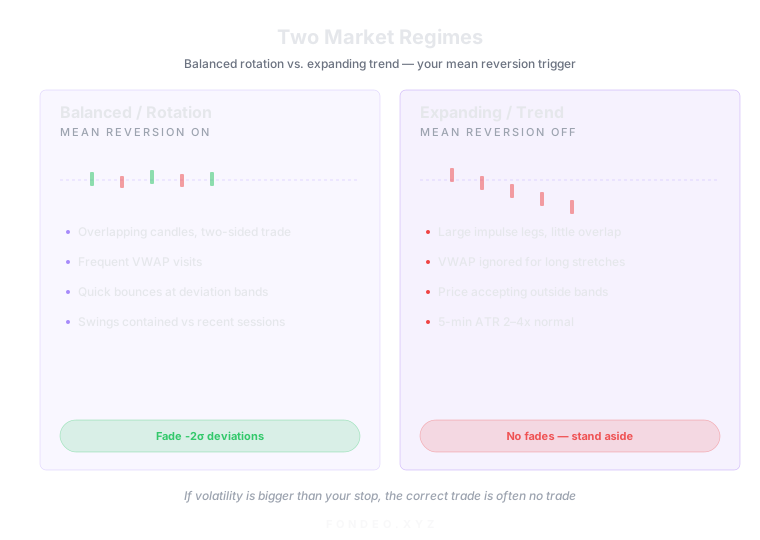
If you trade mean reversion in a prop account, your job is to answer one question quickly:
Is today likely to rotate… or to run?
Balanced (range/rotation) days usually look like:
- Overlapping candles and two-sided trade
- Frequent VWAP visits
- Quick, responsive bounces at deviation levels
- Swings that feel “contained” relative to recent sessions
Expanding (trend/imbalance) days usually look like:
- Large impulse legs with little overlap
- VWAP ignored for long stretches (sometimes all session)
- Price accepting outside bands instead of snapping back
- Bigger 5-minute candles and higher intraday ATR
Here’s the part most traders underestimate: volatility alone can make your market untradable at your size. If 5-minute ATR jumps 2–4x, your “normal” stop is no longer a stop. It’s a coin flip.
Risk reality: If your market is swinging more than your account can absorb, the correct trade is often no trade.
How to Spot Regime Change (A Simple Checklist)
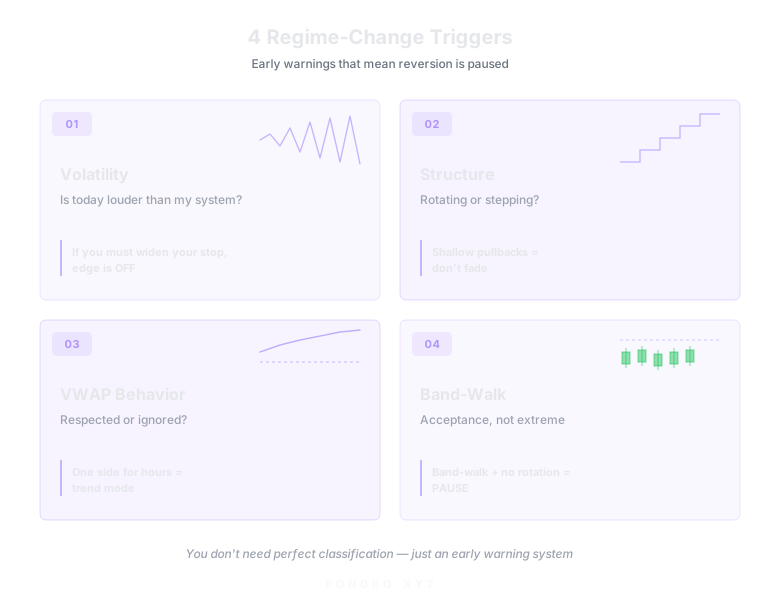
You don’t need perfect classification. You need an early warning system that prevents the death spiral—and cross-asset correlation flips can be one of the clearest regime-change signals.
Volatility trigger: “Is today louder than my system can handle?”
Pick one simple measure and commit to it:
- 5-min ATR vs. your stop size
- Average 5-min candle range vs. your typical target
- Opening range size (first 15–30 minutes) vs. average
Rule of thumb: If your usual stop is getting hit by “noise,” your entries aren’t precise anymore.
Kill-switch rule: If you must widen your stop just to survive the entry, your edge is probably OFF for that session.
Structure trigger: “Are we rotating or stepping?”
- Balanced days rotate: push → pullback → return → push.
- Expanding days step: push → brief pause → push again.
When price is making clean highs (or lows) with shallow pullbacks, fading deviations is like trying to stop a train with a folding chair. Understanding trend structure and whether the market is continuing or reversing will save you from these entries.
VWAP behavior trigger: “Is VWAP being respected or ignored?”
On rotation days, VWAP is visited and crossed.
On trend days, price may:
- Stay on one side of VWAP for hours
- Tap VWAP briefly, then reject and continue
- Use VWAP as a “continuation line,” not a magnet
Band-walk trigger: the silent account killer
When price hugs a deviation band (e.g., riding -2σ lower), the market is telling you:
- This isn’t an extreme.
- This is acceptance.
If you buy every touch, you’re effectively averaging into acceptance.
Non-negotiable rule: If you see a band-walk + no meaningful rotation attempts, mean reversion is paused.
Prop Trading Reality: Your Strategy Doesn’t Get to Decide Risk
A funded trader isn’t paid for being right. You’re paid for being survivable.
Most blowups follow the same pattern:
- Small green days
- One or two huge red days
- Overtrading to “make it back”
If your average losing day is bigger than your average winning day, you don’t have a bad strategy. You have a bad risk container.
The funded-trader principle
You can’t trade your way out of a hole if the shovel is bigger than the ladder.
If you want consistency in a prop trading evaluation (and later, staying funded), you need risk rules that are more powerful than your emotions.
The Pause Protocol: What To Do When Mean Reversion Starts Failing
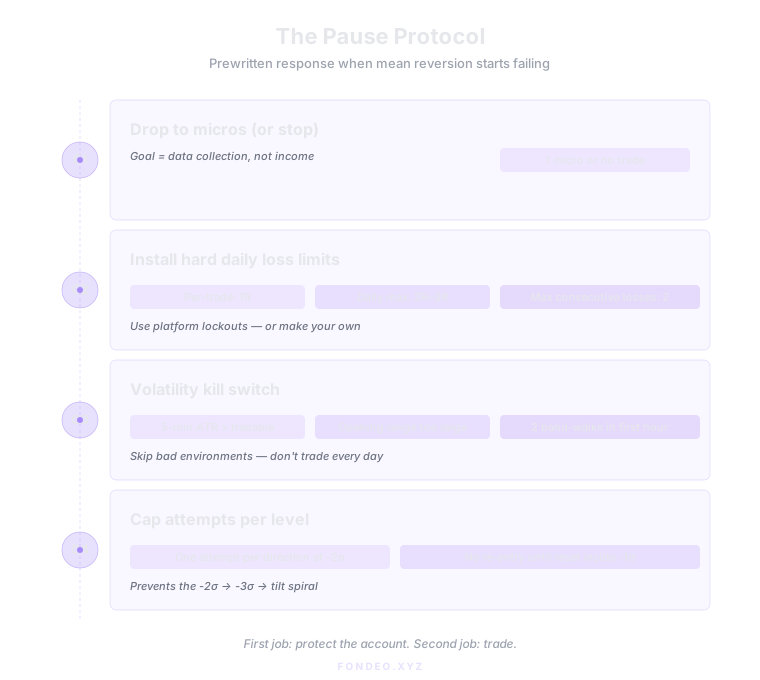
When your VWAP mean-reversion system stops performing, you need a prewritten response. Not intuition. Not “just one more trade.” A protocol.
Step 1: Drop to micros (or stop trading)
If you’re trading futures, this is the fastest way to stop damage without quitting.
- If the system is misfiring, you trade 1 micro or you don’t trade.
- Your goal becomes data collection, not income.
Trading psychology check: If you “need” today’s session to pay bills, you’re not trading—you’re negotiating with fear.
Step 2: Install hard daily loss limits (and honor them)
A daily max loss isn’t optional in prop trading. It’s a seatbelt.
Use a simple model:
- Per-trade risk = 1R (fixed) — and if you're still defaulting to 1% per trade, remember that blanket rule can actually hurt you during losing streaks
- Daily max loss = 2R–3R (then you're done)
- Max consecutive losses = 2 (then you're done for at least 60 minutes)
If your platform supports lockouts, use them. If it doesn’t, you create your own lockout (charts off, platform closed).
Rule: The first job is to protect the account. The second job is to trade.
Step 3: Add a volatility kill switch
Define a volatility threshold that pauses mean reversion automatically.
Examples:
- 5-min ATR above your “tradable” range
- Opening range too large relative to your account size
- Two band-walks in the first hour
Prop traders survive by skipping bad environments. This is especially true in choppy, news-driven markets where mean reversion signals fire constantly but none of them follow through. You don't need to trade every day to pass. You need to not implode.
Step 4: Cap attempts per level
Mean reversion fails hardest when you turn one idea into five attempts. A daily trade cap can prevent this spiral before it starts.
Try rules like:
- One attempt per direction at -2σ
- If stopped, no re-entry until price returns inside -1σ and resets
This prevents the classic spiral: buy -2σ → stopped → buy again → stopped → buy -3σ → now you’re tilted.
How to Modify VWAP Mean Reversion for Trend/Expansion Days (Without Destroying It)
Mean reversion isn’t “bad.” It’s conditional.
If you only have one tool, you’ll try to use it everywhere. The answer isn’t “add -4σ lines.” The answer is trade it only when it’s allowed—and adjust execution when volatility rises.
Require confirmation before fading
Instead of “touch band → enter,” require evidence the move is exhausting.
Confirmation options:
- Break of a micro structure level (e.g., last lower high in a selloff)
- Failure to make a new low/high after a push
- Noticeable loss of momentum (smaller bars, weaker follow-through)—the same logic behind reading 15m doji and topping candles
- Reclaim back inside the band (outside → back inside)
This keeps you out of falling knives.
Entry rule: No confirmation = no fade. You’re not here to be first—you’re here to be funded.
Use time-based exits (not wider stops)
In expansion, widening stops often just increases pain.
Consider:
- Keep your normal stop (your “edge stop”)
- If no rotation starts within X minutes/bars, exit
Mean reversion needs response. If it doesn’t respond quickly, it’s probably not a mean reversion trade.
Change targets: take the first honest profit
On expansion days, expecting a full trip back to VWAP can be fantasy.
Tighten your objectives:
- Partial at the first bounce (e.g., -2σ to -1.5σ)
- Reduce exposure quickly
- Leave a runner only if structure supports it
In a prop account, you’re not building a highlight reel. You’re building a track record.
Add a simple trend filter (so you know when not to fade)
Keep it easy and consistent:
- If price holds one side of VWAP for the first 60–90 minutes, treat the day as potential trend/imbalance.
- If pullbacks to VWAP get rejected quickly, stop fading deviations.
If the market isn’t following your rules, leave it alone.
The Real Blowup Combo: Scared Money + Overtrading
When your account is down and you need trading to work, your brain stops seeing setups. It starts seeing survival.
That’s when you:
- Force trades
- Move stops
- Increase size to “fix it faster”
- Keep clicking after you should have stopped
Overtrading is emotional leakage
If you’re taking 30–50 trades in a day, it’s rarely “more opportunity.” It’s usually one of these:
- Trying to get back to green
- Boredom
- A need to feel in control
Truth: Your best trades are often your first 1–3 trades. After that, edge decays and emotions rise.
This is trading psychology in its most practical form: the goal isn’t to feel good. The goal is to follow your constraints.
One Strategy Is Enough—If You Have ON/OFF Rules
You don’t need a giant portfolio to pass a prop trading challenge.
You need:
- One core setup
- Clear conditions for when it’s allowed
- A shutdown plan when conditions aren’t met
Think like a professional:
- Strategy ON = balanced/rotation day
- Strategy OFF = expansion/trend day
- Alternative plan = a different system (e.g., trend pullbacks) or no trade
If you’re experimenting with 9/21 EMA pullbacks, that’s fine—but keep it structured:
- One market
- One session window
- One setup
- One fixed risk amount
Otherwise it becomes strategy-hopping disguised as “learning.”
Daily Habits That Keep You Funded
This is where careers get built—quietly.
Pre-market regime read (10 minutes)
- Check daily/4H: consolidation or expansion?
- Compare yesterday’s range to the recent average.
- Choose your mode:
- Rotation mode (VWAP mean reversion allowed)
- Trend mode (mean reversion restricted)
- No-trade mode (volatility too high)
Write it down before the open. Your brain needs a commitment before the first candle.
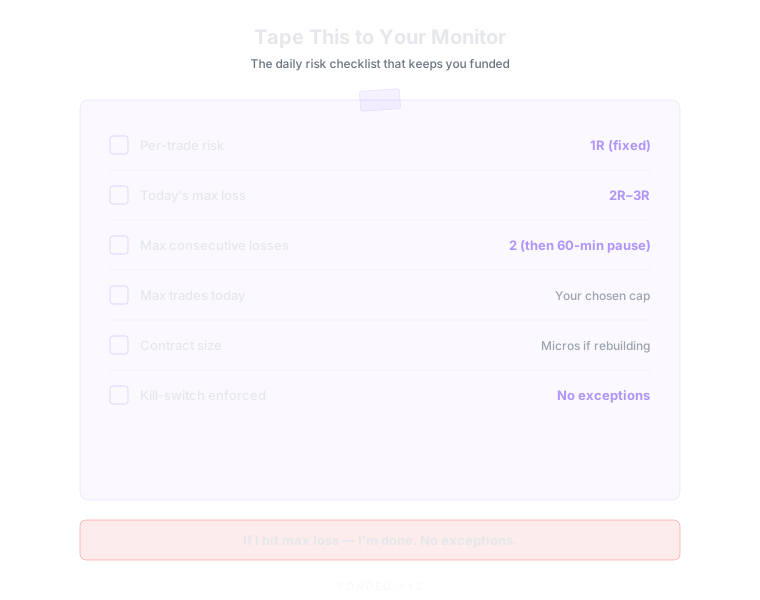
Tape-this-to-your-monitor risk checklist
- [ ] Per-trade risk (1R): ____
- [ ] Today’s max loss (2R–3R): ____
- [ ] Max consecutive losses: ____
- [ ] Max trades: ____
- [ ] Contract size: ____ (micros if rebuilding)
- [ ] If I hit max loss, I’m done. No exceptions.
A journal that actually changes you
Don’t just record entries. Record decisions.
Answer:
- Did I trade the correct regime for my system?
- Did I follow my kill switch rules?
- Did I stop when I was supposed to stop?
- What was I feeling right before my worst decision?
Journaling standard: If your journal never makes you uncomfortable, you’re not being honest enough to improve.
A Quick Scenario: “-2σ Hero” vs. the Funded Trader
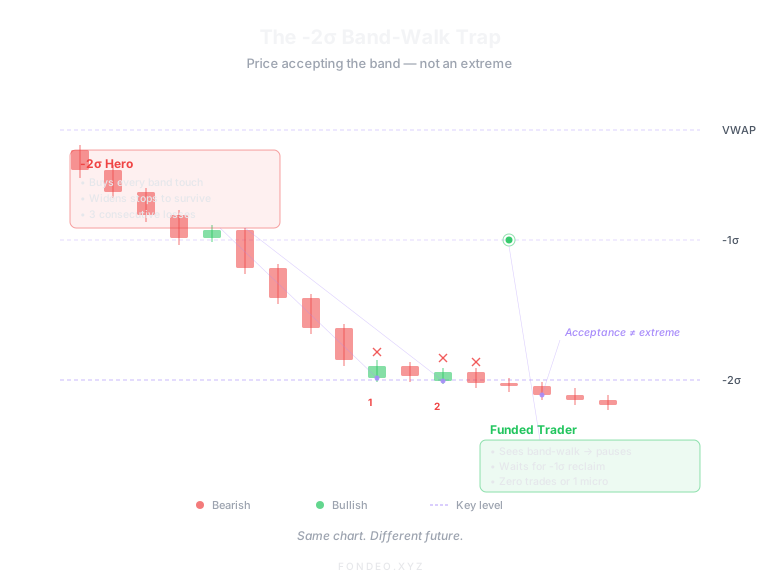
The -2σ Hero
- Sees price hit -2σ
- Buys immediately
- Gets stopped
- Buys again because “it has to bounce”
- Adds -3σ / -4σ bands
- Keeps firing until the account is in survival mode
The funded trader
- Sees price hit -2σ in high volatility
- Checks regime: band-walk + shallow pullbacks
- Takes zero trades or one micro with confirmation
- If the first attempt fails, steps away for an hour
- Preserves capital for the next rotation day
Same chart. Different future.
Your Next 7 Days: A Recovery Sprint (Not a Revenge Tour)
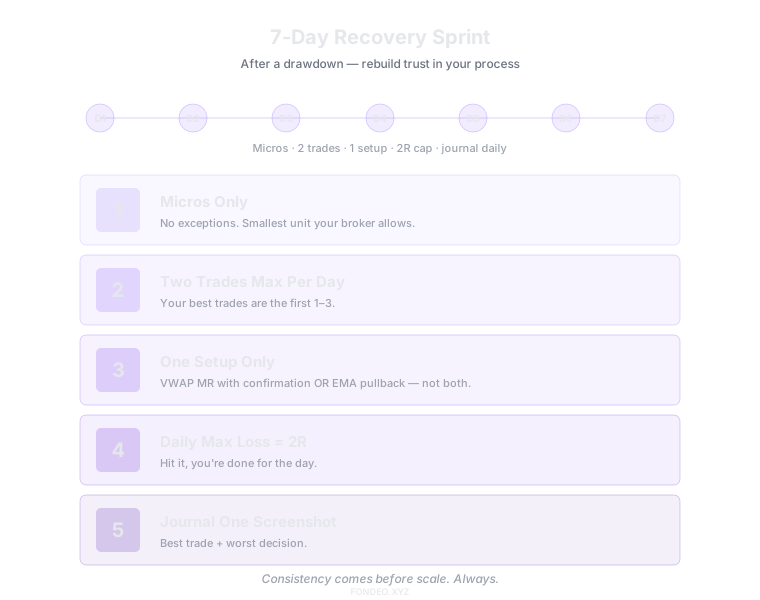
If you’re coming off a drawdown, run this exact plan for one week:
- Micros only. No exceptions.
- Two trades max per day.
- One setup only. VWAP mean reversion with confirmation or EMA pullback—not both.
- Daily max loss = 2R. Hit it, you’re done.
- Journal one screenshot: best trade + worst decision.
Do that for 7 days and you rebuild the one thing that matters most: trust in your process.
Consistency comes before scale. Always.
Final word: Trade like a risk manager
When VWAP mean reversion “stops working,” the solution isn’t more bands and more trades. It’s better filters, tighter risk, and the maturity to pause.
That’s how you pass challenges. That’s how you stay funded. That’s how you turn trading psychology into real results.
If you want a real path to becoming a funded trader—built around discipline, clear rules, and risk management that protects you—start your next step with Fondeo.xyz.
Trade smart,
Jake Salomon