
FOMC days don’t blow prop trading accounts because you’re a “bad” trader. They blow accounts because the market temporarily stops rewarding normal behavior—and you forget your only real job in funded trading: protect the downside.
If you’ve ever watched NQ rip hundreds of points in minutes, get filled 10–20 points worse than planned, get stopped… then reverse and run to your target without you, you know the cocktail: urgency, frustration, revenge trading, and that itchy need to “make the day worth it.”
This article gives you a prop-trading-specific, slippage-aware FOMC playbook you can actually follow.
In Brief
- Build “no setup = no trade” rules so you only participate when price gives your exact setup—not when adrenaline does.
- Size down like it’s non-negotiable and plan for slippage so a single FOMC candle can’t violate your daily loss limit or max drawdown.
- Trade pre-mapped levels with realistic targets (1–2 zones) so you’re not the trader getting shaken out before the real move.
Why FOMC Trades Like a Different Market (And Why Prop Rules Amplify the Danger)
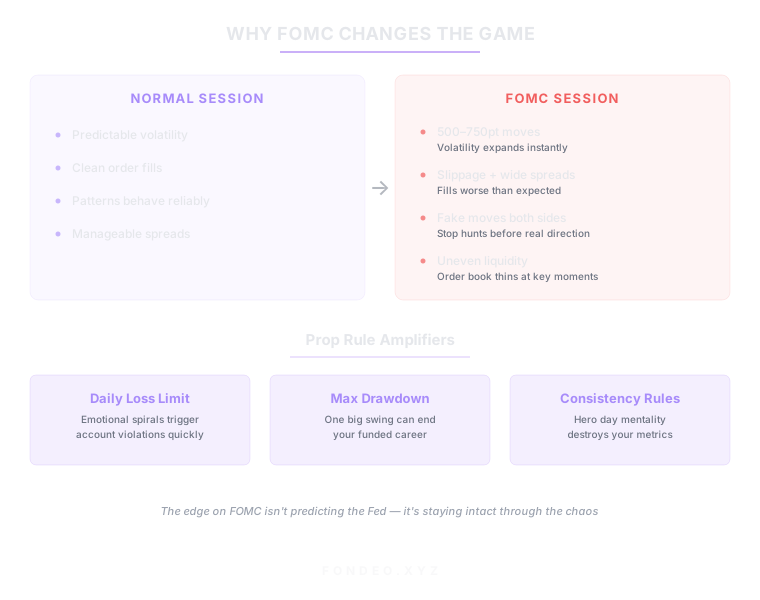
On a normal session, your edge comes from repeatability: familiar volatility, predictable cross-asset correlations, cleaner fills, and patterns that behave.
On FOMC, the market’s personality changes:
- Volatility expands fast—on NQ, 500–750 points in either direction is not a fantasy.
- Liquidity becomes uneven—your stop can fill worse than expected.
- Spreads widen and slippage increases, especially at the statement release and during the first repricing.
- Fake moves are common—price often shakes out both longs and shorts multiple times before the real direction appears.
Now add prop trading constraints:
- Daily loss limits punish emotional spirals.
- Trailing/max drawdown punishes “one big swing” thinking.
- Consistency expectations punish the “hero day” mentality.
So the edge on FOMC isn’t predicting the Fed. It’s staying intact through the chaos and only participating when conditions return to something you can execute.
Tip: FOMC isn’t the day to prove you’re right. It’s the day to prove your risk management is real.
The Core Rule: Trade Only Your Plan… or You Don’t Trade
If price doesn’t give you a predetermined setup, you have no trade. And if you have no trade, you have no business risking capital.
That’s not conservative. That’s professional.
“No setup = no trade” is a risk-management tool
In prop trading, not trading is a position. It protects your drawdown and keeps you eligible to keep trading tomorrow.
If you're viewing FOMC as a "buy the rumor, sell the news" must-trade event, you're already compromised. You're mentally invested before the first candle prints.
Chasing is a tax you can’t afford on FOMC
When price has already run parabolically into the event, you’re not early—you’re exposed.
Chasing on FOMC typically creates an ugly combo:
- late entry
- reactive stop placement
- slippage
- emotional management
That’s how evaluations fail and funded accounts get clipped.
Tip: If you feel the urge to “get in before it goes,” that’s not a setup. That’s FOMO.
Build Your FOMC Map: Levels, Scenarios, and Targets That Make Sense
The simplest way to trade macro events without blowing up is to be reaction-based, not prediction-addicted—the same principle behind building a real prop trading strategy from scratch.
You don’t need 80 lines on your chart. You need a small set of zones where the market has already proven it will react.
Decision zones: what you’re actually looking for
Ahead of FOMC, price often squeezes and trends. Then the event triggers either:
- a sharp continuation—best confirmed with volume-qualified breakouts so you don't chase noise,
- a mean reversion,
- or a stop-hunt whipsaw that clears both sides.
A professional approach is to wait for retracements into meaningful breakout/decision levels and only engage when price shows acceptance.
Here are example zones (NQ-style) that represent the type of mapping you want:
- 26141: breakout area that launched a fast run
- 26059: bounce/consolidation zone
- 25922–25972: major pivot zone where acceptance matters
- 25839: prior area that produced a large run
The story you’re building is simple:
- If bulls hold and accept above key pivots, continuation remains possible.
- If bears reclaim and hold below key breakout zones, downside legs become more likely.
That’s it. You’re not trying to guess Powell’s tone. You’re waiting for price to confirm.
Write 2–3 “if/then” scenarios (this is what keeps you disciplined)
You’re not making a forecast. You’re writing triggers.
Use these templates:
- If price retraces into a major support zone and reclaims/accepts, then I look for my A+ long setup with conservative targets.
- If price rejects a major resistance zone and fails to reclaim, then I look for my A+ short setup with conservative targets.
- If price is whipping through levels with no acceptance, then I am flat—observation only.
That third rule is where funded trader behavior separates from impulse trading.
Tip: On FOMC, acceptance beats touch. A level getting tagged is not confirmation.
Targeting: 1–2 levels, not the whole day
On FOMC, the best prop-trading objective is not “catch the entire move.” It’s:
- survive execution noise,
- take a clean piece,
- protect your downside.
A strong guideline is to target 1–2 logical zones (next resistance/support), then get paid.
Practical execution behaviors on FOMC:
- take partials sooner
- size your runner smaller
- treat the runner as a bonus, not rent money
If you catch even a fraction of a 700-point day with controlled risk, you traded it the right way.
The Position Sizing Rule That Saves Evaluations and Funded Accounts
Be blunt with yourself: on FOMC, normal position size is often reckless size.
If you trade full size into the release and get one bad fill, you can violate your daily loss limit before you’ve even processed what happened.
So here’s the rule:
Size down dramatically. Non-negotiable.
Not “maybe.” Not “if it looks clean.” Not “just this first trade.”
You’re trading a market with unpredictable execution. You must pay for that uncertainty with smaller size.
Prop-trader sizing models you can actually implement
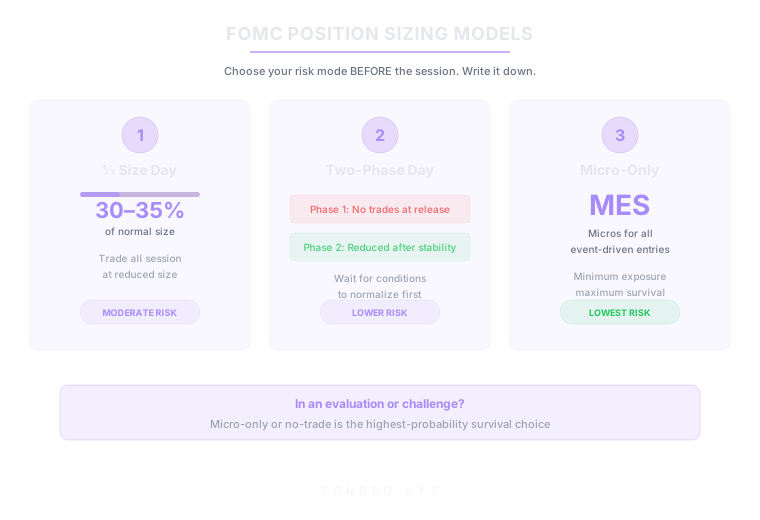
Pick one of these before the session and write it down:
- One-third size day: Trade 30–35% of your normal size all session.
- Two-phase day: No trades during the release window; trade slightly reduced size only after conditions stabilize.
- Micro-only rule: Micros only for any event-driven entry.
If you’re in a prop trading evaluation (challenge/evaluation phase), the highest-probability survival choice is micro-only or no-trade during the release.
Why size is about more than “risk per trade”
On FOMC, you must assume:
- your entry may fill worse
- your stop may fill worse
- your “tight risk” idea can become a large loss
Sizing down is how you keep slippage from turning into a rule violation.
Tip: If realistic slippage could break your daily loss limit, your size is too big—no matter how perfect the setup looks.
Slippage, Stops, and the Trap of “Tight Risk” on Fed Days
A common mistake is trying to “control risk” by tightening stops.
On FOMC, tight stops often become guaranteed stop-outs because the market is sweeping liquidity.
Two acceptable choices (and only two)
- Use structure-based stops (behind a level that truly invalidates your idea) and reduce size to match the larger stop.
- Don’t trade if the required stop becomes unreasonable.
What you cannot do is:
- trade big
- use a tiny stop
- get wicked out
- re-enter out of anger
That sequence blows prop trading accounts.
A slippage-aware pre-trade checklist
Before you click buy/sell on FOMC:
- Is the spread normal or widened?
- Are candles abnormally large for this instrument/time of day?
- Can I survive 5–20 points of slippage (or more) on NQ?
- If my stop fills worse, do I still stay inside my daily loss limit and max drawdown rules?
If any answer is “no,” you’re done. Flat is a valid trade.
No-Trade Windows You Should Respect (So You Don’t Fight the Tape)
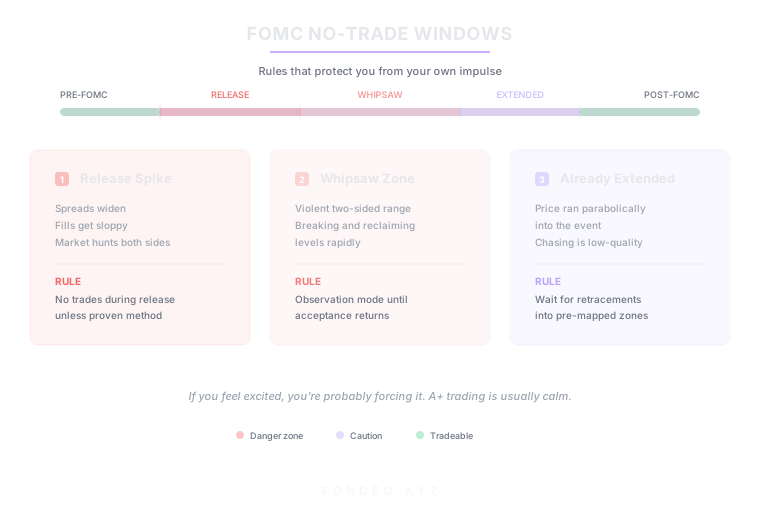
You need rules that protect you from your own impulse.
The release spike window
If you don’t have a proven news-execution strategy, the first minutes after the statement are often untradeable.
This is where spreads widen, fills get sloppy, and the market hunts both sides.
Rule: No trades during the release spike unless you have a tested, rule-based method for it.
The whipsaw window (break/reclaim chaos)
Often price creates a violent two-sided range, breaking and reclaiming multiple levels quickly.
Rule: if price is breaking and reclaiming key levels rapidly, you’re in observation mode until acceptance returns.
The “already extended” window
If price has run parabolically into the event, chasing is low-quality.
Rule: wait for retracements into pre-mapped zones. If you don’t get them, you don’t trade.
Tip: If you feel excited, you’re probably forcing it. A+ trading is usually calm.
Common FOMC Mistakes That Blow Prop Trading Evaluations (And the Fix)
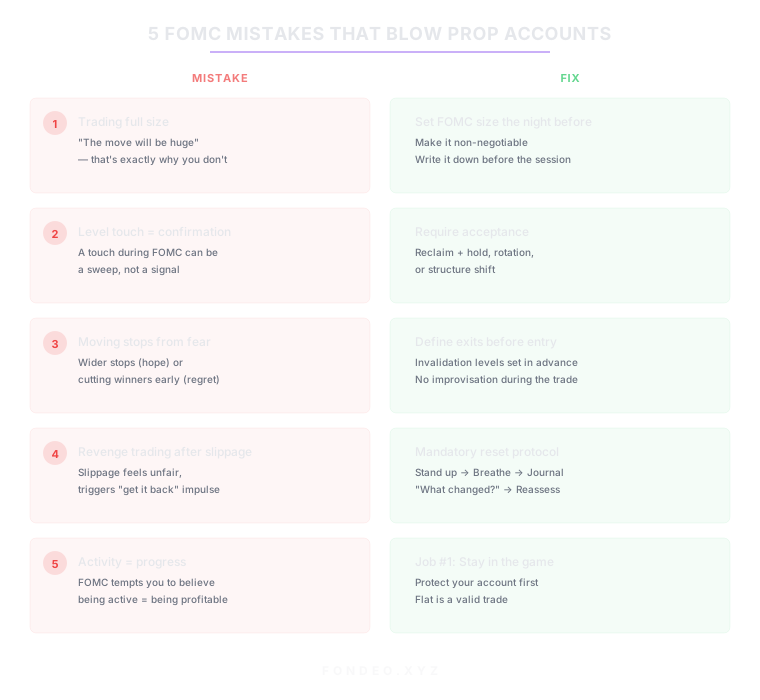
Mistake 1: Trading full size because “the move will be huge”
That’s exactly why you don’t.
Fix: Decide your FOMC size the night before. Make it non-negotiable.
Mistake 2: Treating a level touch as confirmation
A touch during FOMC can be a sweep, not a signal.
Fix: Require acceptance: reclaim + hold, rotation, or structure shift.
Mistake 3: Moving stops because the candle is scary
Fear makes traders do two things:
- move stop wider (hope)
- cut winners too early (regret)
Fix: Define invalidation and exits before entry. No improvisation.
Mistake 4: Revenge trading after slippage
Slippage feels unfair, which triggers “get it back.”
Fix: After any unexpected fill, take a mandatory reset:
- stand up
- breathe
- write one sentence in your journal: “What changed?”
- reassess size and conditions
Mistake 5: Confusing activity with progress
FOMC tempts you to believe that being active equals being profitable.
Fix: Your job as a funded trader is to stay in the game. Protect your account first.
Your FOMC Game Plan (Copy/Paste This)
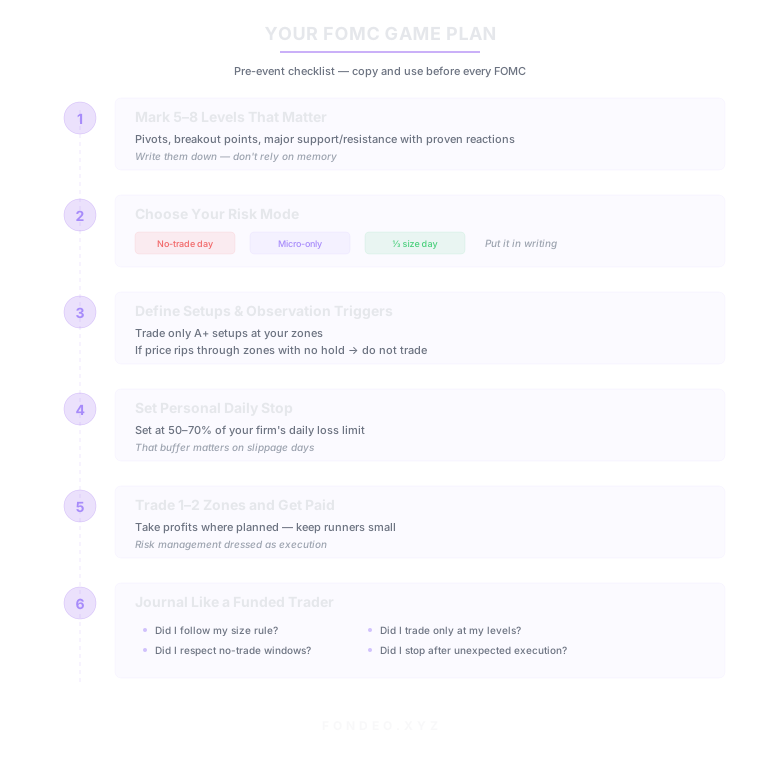
Use this as your pre-event checklist.
Step 1: Mark 5–8 levels that matter
Choose zones with proven reactions: pivots, breakout points, major support/resistance.
Write them down. Don’t rely on memory.
Step 2: Choose your risk mode for the day
Pick one:
- No-trade day (best if discipline is shaky or you’re protecting an evaluation)
- Micro-only day
- One-third size day
Put it in writing before the session.
Step 3: Define your setups and your “observation only” triggers
Example rules:
- I trade only my A+ setup at my zones.
- If price is ripping through zones with no hold, I do not trade.
Step 4: Set a personal daily stop under the firm limit
If your prop firm daily loss limit is $X, set your personal stop at 50–70% of X.
That buffer matters on slippage days.
Tip: A personal daily stop is how pros avoid turning one messy day into a failed evaluation.
Step 5: Trade for 1–2 zones and get paid
Take profits where you planned. Keep runners small.
This is risk management dressed as execution.
Step 6: Journal like a funded trader
After the session, answer:
- Did I follow my size rule?
- Did I respect no-trade windows?
- Did I trade only at my levels?
- Did I stop after unexpected execution?
Your trading psychology improves fastest when your review is honest.
Habit-Building: Become the Trader Who Thrives When the Market Gets Loud
You don’t become consistent from one perfect FOMC. You become consistent by repeating simple non-negotiables.
Write your FOMC non-negotiables (and keep them visible)
Examples:
- I will not trade full size.
- I will not chase parabolic moves.
- I will not trade without acceptance at a level.
- I will stop after two losing trades or one major slippage event.
Simple rules. Hard discipline.
Train boredom tolerance (this is a real edge)
The trader who can sit on their hands while others gamble is the trader who lasts long enough to get funded—and stay funded.
Tip: You don’t get paid for activity. You get paid for good decisions.
Redefine “winning” on event days
If you sized down and followed rules—even with smaller profits—that’s a win.
If you stayed flat during chaos and protected your drawdown—that’s a win.
Consistency over intensity.
A Realistic FOMC Scenario: Two Versions of You
Version A (the hero): You trade normal size into the release. You get slipped. You take a second trade to “fix it.” You get wicked out again. Your daily loss is gone. The market eventually trends cleanly—without you.
Version B (the funded trader): You sized down dramatically. You waited for price to return to a pre-mapped pivot zone (for example, a 25922–25972-style acceptance area). You waited for acceptance, took a conservative move to the next level, scaled out, and stopped when conditions turned messy.
Version B won’t always have the biggest day.
But Version B survives.
And in prop trading, survival is what gets you paid.
Bring this back to the truth:
- FOMC is not a test of prediction.
- It’s a test of risk management and trading psychology.
Implement the no-trade rules, size down like it’s non-negotiable, and commit to trading only at your levels with real acceptance.
When you’re ready to apply this with the same discipline inside a prop trading path built for consistency, start your funded trader journey at Fondeo.xyz.
Trade smart,
— Jake Salomon
Disclaimer: This content is for educational purposes only and is not financial advice. Trading involves risk. You are responsible for your decisions and risk management.